The Value of College Is More Than a Paycheck: Why Equity Must Be Part of the Equation

OBBBA attempts to hold colleges accountable by tying value to graduates’ earnings, but it may unfairly penalize MSIs and community colleges that help students succeed

article-cropped December 05, 2025 by Hailey DeMars, Mia Schaubhut
Hispanic female student looks pensive while holding a book in a crowded sitting area on a college campus.

Public confidence in higher education has fallen sharply in recent years: Fewer than 1 in 4 Americans now believe a four-year degree is worth the cost if it comes with student debt. This skepticism is fueled by rising prices that necessitate borrowing, along with deep disparities in who benefits from a degree. Nevertheless, higher education remains one of the few engines of mobility that can uplift entire communities — if we measure and support it equitably. The challenge ahead is not proving whether college is a worthwhile investment but ensuring that its benefits are distributed fairly across race, income, and geography.

The recently passed One Big Beautiful Bill Act (OBBBA) brings sweeping changes to student loans, Pell Grant eligibility, and institutional accountability by tying program performance to graduates’ earnings. Applying an earnings threshold to all programs seems like a reasonable step toward ensuring that public dollars support institutions that fulfill their promises to students and taxpayers. But while this approach can help direct federal investments toward programs that lead to real financial gains for graduates, relying on wages alone as the primary measure of value risks penalizing the very schools and student populations these reforms are meant to support.

Additional Considerations for Calculating Return on Investment

In higher education policy, there is no shortage of ROI frameworks that compare graduates’ average earnings to those of individuals without a degree and across institutions and programs. Yet, these metrics often emphasize absolute earnings without accounting for key factors that influence economic outcomes, including local labor market conditions, racial wage gaps, and varying levels of institutional resources. As a result, minority-serving institutions (MSIs) and community colleges may be unfairly labeled as “low performing,” not because they fail to deliver value, but because their students start with fewer financial resources, and the institutions themselves operate with less funding and limited support. Despite this, these schools routinely provide transformative pathways to economic and social mobility for the students they serve.

Our analysis, conducted in partnership with EdTrust and Stanford University’s data science & social systems capstone project, builds on the Race and Economic Mobility (REM) metric developed by The Institute for College Access & Success (TICAS). We performed program- and institution-level regressions using U.S. Department of Education College Scorecard data and regional labor-market indicators, such as state GDP, unemployment, and labor-force participation.

To capture relative mobility rather than absolute wages, we created an earnings-to-family-income ratio defined as graduates’ median earnings 10 years after enrollment divided by their median family income upon entering college. This metric shows how far students have progressed economically relative to their starting point. After controlling for institution type, racial composition, and regional context, we found that two-year colleges have earnings-to-income ratios approximately 25 percentage points lower than those of four-year institutions — differences that reflect racial inequality in labor markets rather than institutional failure.

Institutions with high Black and Latino enrollment often have lower absolute graduate earnings but higher earnings-to-family-income ratios, signaling greater upward mobility; yet these nuances are lost in the new earnings metrics

Changes Introduced by the One Big Beautiful Bill Act

Unfortunately, OBBBA doubles down on earnings thresholds in its new higher-education accountability framework, expanding these earnings-based metrics to a wider range of institutions and degree types. Although it borrows elements from earlier gainful employment regulations, OBBBA significantly redefines how programs are evaluated and which remain eligible for federal loans. For a detailed overview of the new accountability structure and its implications, see EdTrust’s analysis in “Making the New Higher Education Accountability Framework Pay Off.”

Questions of value and equity were central to our Stanford data science capstone project, where we examined the return on investment (ROI) of MSIs and community colleges — institutions that traditional ROI models often undervalue despite their crucial role in expanding opportunity. Our goal was to reframe ROI in ways that recognize and reward institutions serving students who have long been excluded from higher education’s full economic benefits.

Yet OBBBA’s metrics risk penalizing programs that serve the public good. According to an Urban Institute analysis, more than half of borrowers in associate degree programs in human development, health services, and teacher education would fail the new earnings test.

These programs disproportionately enroll women, students of color, and individuals from low-income backgrounds, and they frequently lead to public service careers such as teaching and caregiving. Because these professions offer modest wages despite their significant societal importance — and because OBBBA does not adjust for labor market context or social value — the framework may end up punishing the very programs that prepare individuals for vital public service careers.

Effects of Accountability Frameworks on Institutional Access

Our findings indicate that the Big Beautiful Bill will disproportionately impact MSIs and community colleges. Although initial analyses suggest that MSIs are largely unaffected by low-earning program thresholds, the data tells a more complex story. It shows that 63% of non-MSIs and 74% of HBCUs have no students in low-earning programs, which also means that roughly 1 in 4 HBCUs still have students enrolled in programs that may be flagged. While many MSI students are in programs above the threshold, a substantial share are in programs that could face increased scrutiny or risk under the new rules.

The current federal metrics do not control for race and income; they rely solely on raw income. MSIs and community colleges typically serve higher proportions of Pell-eligible, first-generation students, and students of color, yet the value these institutions provide — particularly their success in promoting relative economic mobility — is not reflected in raw earnings measures. Institutions with high enrollments of Black and Latino students often report lower average earnings but higher earnings-to-family-income ratios, signaling their positive impact on upward mobility. Overlooking race and income in federal metrics leads to misinterpretation and misclassification.

Some for-profit colleges have claimed that low graduate earnings are a reflection of student demographics rather than program quality — a claim refuted by extensive oversight findings showing persistent quality and accountability issues. In contrast, many MSIs and community colleges that enroll similar populations demonstrate strong relative mobility outcomes, underscoring the need for accountability metrics that recognize both student background and institutional impact.

By focusing solely on raw earnings data — just one small piece of a much larger puzzle — the federal framework risks undermining funding for institutions that deliver meaningful economic and social mobility for the students who need it most.

More Equitable Ways to Measure Value

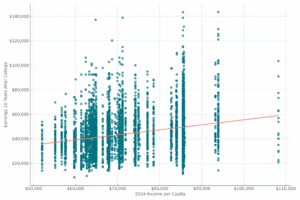
Figure 1. 2024 Income per capita vs. earnings


A line graph labeled 2024 income per capita on the horizontal axis and Earnings 10 years after college on the vertical axis

Sources: Stanford Data Science Capstone Group 1 analysis of Department of Education College Scorecard, 2022-23; Bureau of Economic Analysis (BEA), Personal Income by State, 2024.

Equitable ROI models empower students, families, and policymakers to make better-informed decisions about higher education — decisions grounded not just in earnings but in broader measures of impact and opportunity. Here are a few ways current models can be strengthened:

  • Integrate regional labor market data

Local economies shape post-college earnings. Colleges in struggling regions often underperform on ROI, not because of program quality, but because of the zip codes their students return to. As shown in Figure 1, there is a modest positive relationship between state income per capita and graduate earnings 10 years after college — institutions in higher-income states tend to see stronger ROI outcomes. Our analysis found that a 10-percentage point increase in income per capita was associated with roughly a $5,654 boost in graduate earnings, underscoring how regional economic conditions can inflate or depress institutional performance independent of educational quality.

  • Use earnings-to-income ratios to track upward mobility

Absolute earnings don’t tell the whole story. Comparing graduates’ earnings to their family’s pre-college income or local benchmarks better captures mobility, especially for first-generation students and students from low-income backgrounds.

  • Account for institutional mission and student demographics

Continuing to measure all institutions by the same yardstick ignores differences in whom they serve, where they’re located, and what outcomes they’re designed to advance. Unlike for-profit colleges that invoke student demographics to justify weak outcomes, community colleges and MSIs serve similar populations yet consistently deliver meaningful gains in mobility and access. Recognizing these distinctions is essential: accountability frameworks should reward institutions that advance equity, not penalize those that serve students with the fewest resources.

Measuring What Matters

College value cannot — and should not — be reduced to a paycheck. ROI should not only be about where students land but also how far they’ve come. Strong federal accountability for program quality is essential; students and taxpayers deserve to know that their investments lead to real economic gains. But to be truly fair and effective, these measures must also reflect broader contributions to mobility and the public good — metrics that reflect opportunity, not just outcomes.

Note: This blog reflects research and analysis conducted in partnership with EdTrust and Stanford University’s data science & social systems capstone project. We thank EdTrust for amplifying our perspectives and findings as students.

Hailey DeMars is pursuing a bachelor’s degree in environmental & data science at Stanford University. Mia Schaubhut earned a bachelor’s degree in data science & social systems from Stanford University in 2025.

As part of our commitment to elevating diverse perspectives, EdTrust occasionally features guest blogs. The views expressed are those of the author and do not necessarily reflect EdTrust’s views or positions.

Photo by Allison Shelley/Complete College Photo Library