Cost of attendance (COA) is supposed to answer a simple question: What will college cost me? By law, every college that participates in federal student aid must publish a full cost of attendance, covering tuition, fees, housing, food, books, transportation, and personal expenses. But institutions have a lot of discretion in how they calculate those numbers, meaning there is not a prescribed detailed and uniform methodology on how to calculate housing, transportation, or “other personal expenses.” As a result, colleges can report very different costs for students in similar circumstances, sometimes even when those schools are in the same region and face similar local living costs.
Texas is one of the few states that has begun addressing this challenge at the policy level, setting standards for how the cost of attendance is presented (but not calculated), across public colleges rather than leaving the COA formatting up to each college.
A scholarship that looks generous on its own can cover very different shares of the total cost depending on how high that school’s cost of attendance is. And families can only make that comparison if every school is reporting costs in the same way.
For EdTrust, this work matters because affordability is not just about the sticker price of tuition and fees. Non-tuition expenses are the fastest growing driver of college costs, now making up the bulk of what students pay, especially in Texas where the state has frozen tuition rates for the last four years.
It is about whether the full cost of college, once housing, food, and other expenses are counted, is something students can realistically manage, particularly those who don’t fit the dependent, full-time student that cost of attendance estimates are typically built around, including student-parents, adult returners, and part-time students.
Why Uniform Cost of Attendance Matters for Families
A shared structure means students do not have to decode a new format every time they research a different school. When every institution reports costs the same way, families can compare numbers side by side and make more informed decisions before they commit to where to apply and enroll.
Additionally, a consistent cost of attendance makes it easier to see how far a scholarship goes at one school compared to another. A scholarship that looks generous on its own can cover very different shares of the total cost depending on how high that school’s cost of attendance is. And families can only make that comparison if every school is reporting costs in the same way.
That is a meaningful improvement over a system where each college decides on its own how much detail to share and how to present it.
A Closer Look Into What Texas Law Says
Public universities must follow these standards, but private and independent schools do not have to, though the state law encourages them to use the same approach and to link the same financial aid resources.
The Texas Higher Education Coordinating Board is required to maintain a statewide net price calculator website with information for all public institutions. Having a statewide net price calculator gives a full-time, first-time student a single starting point for estimating what they might pay after grant aid. Texas requires schools to submit their net price federal data to avoid schools building a separate calculator with different data.
A Texas college’s website or any printed materials meant to give prospective students cost of attendance information must conform to the uniform standards to present figures that reflect the upcoming year’s costs. The state net price calculator, on the other hand, is built from the previous year’s cost and aid data.
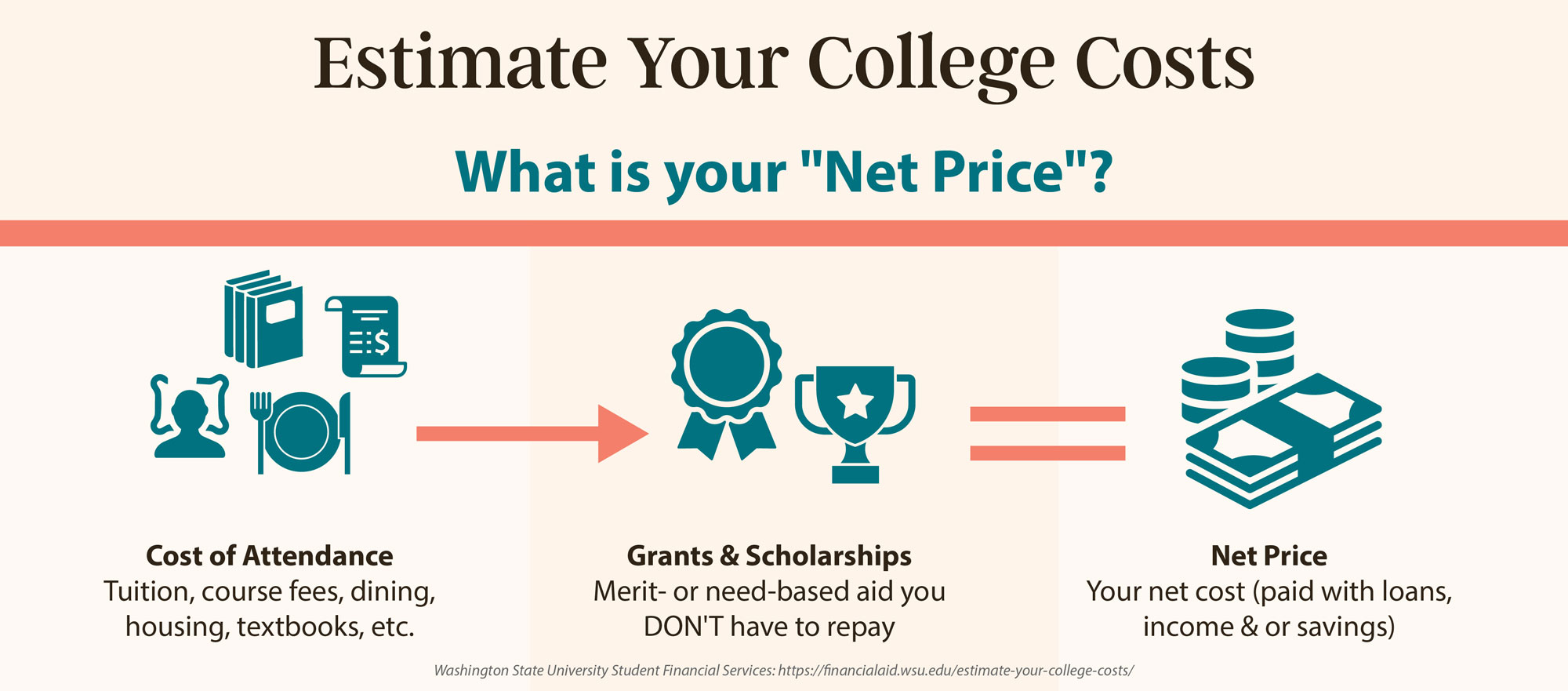
The net price and cost of attendance can differ for two reasons: net price reflects cost after financial aid is applied, while cost of attendance reflects the total cost before aid. On top of that, the two figures are rarely calculated in the same year, since net price calculators rely on the prior year’s cost and aid data while cost of attendance reflects projected costs for the upcoming year.
Currently, California appears to be the only state addressing year-to-year Consumer Price Index (CPI) increases in cost of attendance, having passed the GAINS for Student-Parents Act (AB 2458) in 2024, requiring community colleges to apply CPI adjustments to non-tuition cost estimates in years between student expense surveys.
Why Presentation and Calculation Practices Matter
A Texas college could follow the state’s formatting rules perfectly, while still using estimates for housing, food, and other expenses that are much lower or higher than what students pay in that area. A shared format makes it easier for families to compare schools side by side, but it does not guarantee that any single school’s numbers accurately reflect what it costs to live there.
Inaccurate cost of attendance calculations could lead to underestimating or overestimating the true cost. Underestimation can potentially lead to students not getting sufficient aid that they need and facing a larger affordability gap because of inaccurate net price calculations. On the other end, overestimation could lead to scaring students away or over-borrowing.
While having standardization policies is helpful to avoid confusion and unnecessary variation, average estimates may not be accurate for some student populations, including incarcerated, undocumented, and student-parents. Texas is pushing to pass similar legislation like California’s GAINS Act to account for childcare expenses in financial aid calculations. A recent study found that 1 in 5 students who identified as a caregiver reported missing at least one day of class during the semester because of childcare challenges.
In practice, standardization means Texas colleges are expected to organize cost of attendance information for on- and off-campus around the same basic categories for: tuition and fees, room and board, books and supplies, transportation, and personal expenses.
But even within a required category like “personal expenses,” the law only standardizes the label, not how they calculated the dollar amount. One Texas school defines personal expenses as covering things like clothing and toiletries, while another describes it more broadly as miscellaneous items related to educational costs. Families comparing two schools’ personal expenses figures may be comparing numbers built on different assumptions about what’s included.
Cost Transparency is Half the Story
Cost transparency matters most for the students who have the least room for financial surprises. EdTrust’s research on the affordability gap shows that students from low-income backgrounds are often left with thousands of dollars in costs after grants, scholarships, and a reasonable amount of work earnings are factored in. Trellis Strategies’ State of Student Aid in Texas report reveals that just 35% of students with $10,000 or more in unmet financial need graduate within six years, compared to 62% of students with no unmet financial need.
Although clearer cost information helps students and families have a more complete picture of their unmet need and the difference in cost when selecting an institution, without additional need-based aid, including emergency aid, transparency efforts may not improve student enrollment and persistence.
The Takeaway
Texas stands out among states for building clear legal requirements around cost of attendance transparency and backing it with a statewide net price calculator. That is a real step forward for students trying to compare their options. But standardized reporting is not the same as an affordable college education.
Texas, and other states considering similar policies, will need to continue improving upon the accuracy of their estimates and stronger need-based aid working together to make college genuinely affordable for the students who need affordability the most.
Photo by Allison Shelley/Complete College Photo Library


 September 22, 2026 by Sabreyna Reese