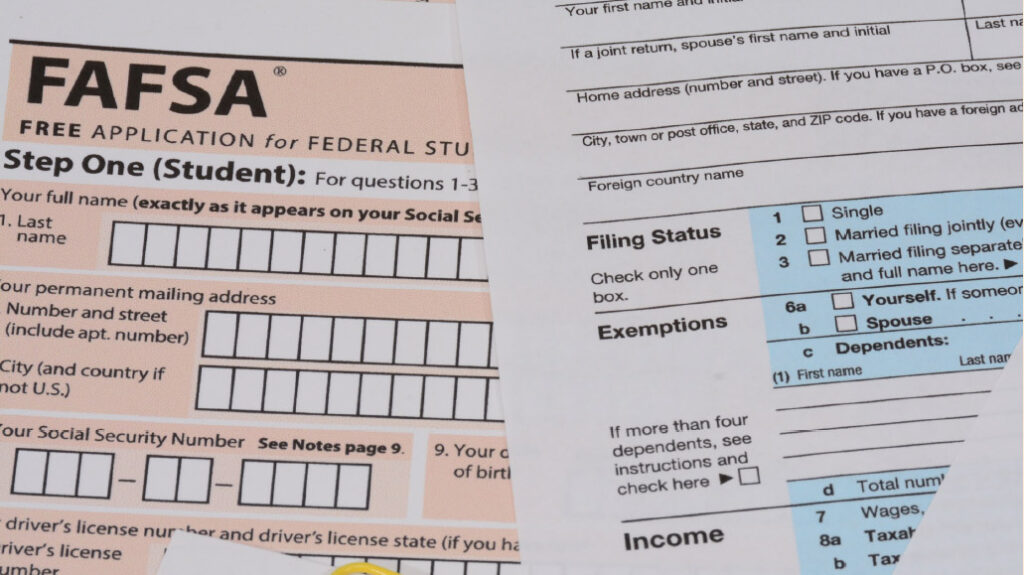
Higher education isn’t a luxury; it’s a lifeline. Yet, for students from communities where opportunities are scarce and the odds are stacked against them, it can seem like an unattainable dream. The key to realizing that dream often hinges on a single form, as I learned firsthand.
That form is the Free Application for Federal Student Aid—better known as the FAFSA.
I remember what it feels like to believe that college is out of reach —not because I lacked intelligence, ambition, or grit, but because life continually suggested that it wasn’t meant for “kids like me.” I’m the daughter of Dominican immigrants, raised in the low-income community of Central Falls, Rhode Island, by a single mother who managed unpaid bills with quiet, unwavering strength.
Consequently, college always felt like a distant dream. How could I imagine dorm rooms, degrees, or a future beyond my community when I watched my mother stay up late each week, weighing rent against groceries and heating our apartment against buying school clothes?
It wasn’t a lack of ambition that held me back; it was the weight of reality.
Then, everything changed with a single question. A counselor from my Upward Bound program looked me in the eye and asked, “Have you filled out the FAFSA?”
I hadn’t. I didn’t think it mattered. College felt like a future that belonged to someone else — someone with money, connections, and a safety net. That question, though, opened a door I didn’t even know existed.
Filling out the FAFSA unlocked the financial aid I needed, turning my college dreams into reality. It enabled me to graduate with minimal student debt, build a career I once couldn’t have imagined, and provide my daughter with the bright future my mother wished she could have given me.
Sadly, many students in Massachusetts never get the chance to attend college. Not because they lack the drive or talent, but because they don’t fill out the FAFSA.
During the 2024-25 application cycle, only 49% of high school seniors in Massachusetts completed the FAFSA. The state ranks 14th in the nation for FAFSA completion, and last year, Massachusetts students left $63.9 million in unclaimed Pell Grants— funds that could have transformed lives.
We cannot accept this as the norm.
That’s why EdTrust in Massachusetts supports H.4409 and S.2533, legislation championed by uAspire and backed by students, educators, and researchers. These bills would establish a universal FAFSA policy, requiring all high school seniors to complete the FAFSA in order to graduate. Support systems would be provided, along with an opt-out option for families who need it. The goal is simple: to guide, not pressure; to include, not exclude.
“Financial aid plays a crucial role in determining whether a student decides to pursue a degree, especially for those from low-income households. We have the opportunity to support more students in completing the FAFSA to ensure they make informed choices about their plans after high school,” said Femi Stoltz, Massachusetts policy director at uAspire.
And we know that such policies work.
- Louisiana was the first state to implement a universal FAFSA requirement, and in just one year, completion rates jumped by 11 percentage points.
- Alabama saw a 13.6% increase in FAFSA submissions and an 11.8% increase in FAFSA completions among the high school class of 2022 — the first cohort required to submit the FAFSA.
- Similarly, after implementing a FAFSA graduation requirement, Texas experienced substantial gains in financial aid. For the same graduating class, Texas reported a 13.9% rise in FAFSA submissions and a 12.5% increase in FAFSA completions.
Completing the FAFSA is one of the strongest predictors of college enrollment. In a state that is home to some of the world’s best colleges, letting a form stand in the way of a student’s future is unacceptable.
This is more than policy. It’s a promise.
As student loan policies become increasingly complex and burdensome, access to higher education is at risk —especially for students from low-income backgrounds. Now more than ever, universal FAFSA is essential. By making the FAFSA more accessible, we can significantly increase college application completion rates, spark critical conversations between students and counselors, ensure that students understand all available financial aid options, and close the opportunity gap between students from low- and high-income backgrounds.
We’ve taken the first step by requiring schools to notify students about the FAFSA, but awareness alone isn’t enough. Now is the time to move from awareness to access, from intent to impact, and from hope to policy.
I urge our legislators, educators, and community leaders to support and pass H. 4409 and S. 2533. Let’s ensure that every student in Massachusetts — not just the fortunate few— has an equal opportunity to pursue higher education.
Sometimes, all it takes is one form and one bold decision to believe in every student’s future.
Femi Stoltz, Massachusetts policy director at uAspire, contributed to this blog.


 February 04, 2026 by Chanthy Lopes Toro