In the latest chapter of the Great American Heist — the sweeping and coordinated effort to strip resources from students, families, and communities and funnel them upward to the wealthy — the Trump administration has now set its sights on one of the most vulnerable groups in higher education: student-parents.
Recently, the U.S. Department of Education announced it will transfer the Child Care Access Means Parents in School (CCAMPIS) program to the Department of Health and Human Services (HHS). CCAMPIS is the only federal program dedicated to helping student-parents from low-income backgrounds access affordable child care so they can stay enrolled and complete college. The administration claims the move will “streamline” federal operations. In reality, this is not streamlining. This is sabotage. The move is part of an explicit plan to dismantle the Department of Education, bypass Congress, and eliminate programs that help students who need it the most. One in 5 college students are parents, and student-parents are disproportionately women, Black, Latino, first-generation, and from low-income backgrounds. Now, they are being set up to fail.
CCAMPIS is a higher education support program, not a general child-care subsidy. The program belongs within the agency that oversees colleges and universities, not inside one that administers hugely complex systems like Medicare and Medicaid
The administration argues that HHS is better suited to run CCAMPIS. This claim does not stand up to scrutiny. CCAMPIS is a higher education support program, not a general child-care subsidy. The program belongs within the agency that oversees colleges and universities, not inside one that administers hugely complex systems like Medicare and Medicaid. The Department of Education already runs CCAMPIS efficiently, with no evidence of duplication or waste. In fact, ED operates some of the leanest administrative structures of any federal agency, particularly within federal student aid and higher education programs. HHS, by contrast, oversees massive support programs with far higher compliance costs. Moving a small, targeted higher education program into a massive agency designed for large-scale benefits administration is not efficiency but a deliberate weakening of CCAMPIS’s purpose and reach — one that will create confusion, new bureaucratic hurdles, and more distance between the program and the students it serves.
NPR reporting shows a strategy to outsource Department of Education responsibilities and weaken the agency’s legal and operational authority. Officials driving this restructuring, such as Lindsey Burke — who co-authored the Project 2025 blueprint calling for the elimination of the Department of Education — have repeatedly argued that the federal Department of Education should not exist. Per NPR, these agreements were described as a way to “sidestep Congress and outsource large pieces of the U.S. Department of Education” and as part of a broader plan to “break up the federal education bureaucracy.” This is a deliberate restructuring designed to dismantle the agency that Congress created specifically to protect students’ rights and operate federal higher education programs.
This is not speculation. The administration already tried to eliminate CCAMPIS in its FY2026 budget, claiming it duplicates other child-care programs. The House Appropriations Committee followed suit by proposing to eliminate CCAMPIS funding entirely. Together, these actions show a clear pattern: rather than support one of the only federal supports for student-parents, the administration is moving CCAMPIS out of the Department of Ed, where its statutory authority resides, in what is a prelude to sunsetting the program, not strengthening it.
As EdTrust senior vice president, Dr. Wil Del Pilar, underscored in his recent congressional testimony, today’s students — many of whom are working, parenting, and facing rising unmet needs — cannot innovate their way out of underinvestment. This makes cuts to supports like CCAMPIS especially harmful.
EdTrust’s analysis shows that student-parents at public two-year colleges pay over $20,000 dollars than their peers without children per year
All of this is happening at a time when student-parents face the steepest financial barriers in higher education. Amid the rising costs of living, child care is the fastest growing expenditure (behind housing), so student-parents often face untenable obstacles. In fact, child care for one child costs more than rent in 17 states and more than in-state college tuition in 28 states. Further, EdTrust’s analysis shows that student-parents at public two-year colleges pay over $20,000 dollars than their peers without children per year. This affordability gap, which includes tuition, housing, transportation, and child care, is more than five times larger than what dependent students face. Across the country, student-parents would need to work between 40 and 80 hours per week to close the gap — an impossible workload even for part-time college students. There is not a single state in which a student-parent can work 10 hours per week at minimum wage to cover both tuition and child care — forcing many parents to make difficult choices on whether to pursue their college degree or earn far less to provide for their families.
These realities illustrate why CCAMPIS matters. It is one of the only federal programs designed around the realities that student-parents face as they work to complete a degree or credential. Rather than eliminating CCAMPIS, Congress should be reauthorizing and expanding it so the program can finally meet the level of real needs of student-parents nationwide.
At the same time, some institutions are proving what real solutions look like. The College of Health Care Professions (CHCP) uses data to understand and support student-parents and has implemented a two-day, on-campus model that reduces commuting and child-care costs, demonstrating how institutions can innovate to meet student-parents’ needs. Programs like CCAMPIS are essential for helping colleges build the child-care capacity their students deserve.
Even the administration’s own language shows that efficiency is not the real goal. Its press release frames these agency transfers as “cutting red tape” and “lessen[ing] the administrative burden on states.” The Great American Heist describes the same mission: shifting public resources and authority away from students and toward privatized and unaccountable systems.
The plan to move CCAMPIS fits squarely within a cruel and dangerous pattern of undermining education at every level. It weakens the only federal program that directly helps student-parents remain enrolled and graduate college. It places this program in an agency with no higher education mission. And it sets the stage for funding cuts that student-parents cannot afford.
Student-parents deserve programs that support their path to a degree, not political maneuvers that undermine it. Moving CCAMPIS is a direct attack on access, equity, and the future of millions of families. And it’s duplicitous: This administration touts the importance of family and boosting birth rates, yet they are simultaneously dismantling the very child-care supports and educational pathways that student-parents rely on to build stable futures for their families.
Congress must act. Lawmakers should reauthorize and expand CCAMPIS so it can meet the real level of need on campuses, strengthen oversight of agency actions that sidestep statute, and stop the Great American Heist by rejecting policies that strip resources from the students and communities that need them most.
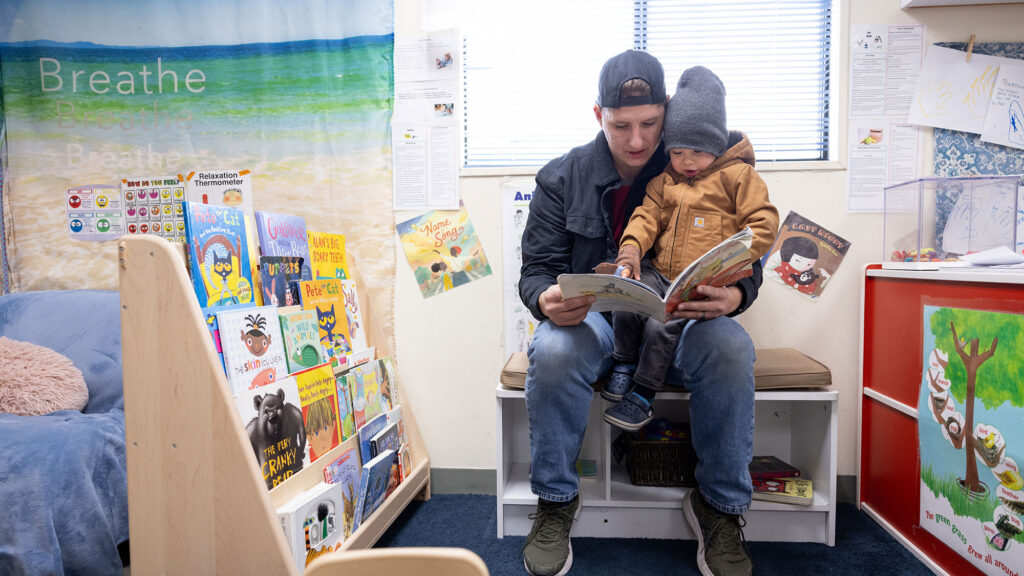
Photo by Allison Shelley/Complete College Photo Library

 December 02, 2025 by Jinann Bitar