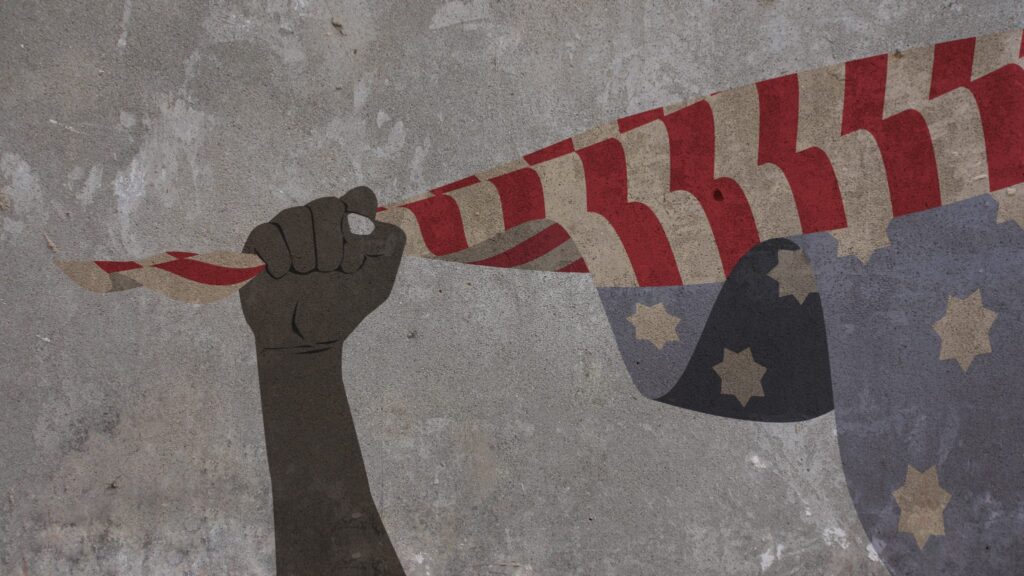
July 4th is a time to come together and celebrate the contributions of every person who has worked to build out the ideals of the United States. It is also a time to reflect on promises unkept, which should prompt us to redouble efforts to demand that the nation’s promises extend to every American, not just a privileged few.
I believe in the hope and vision of American democracy and in the ability of this country to expand democratic principles to every person and group living within its borders. I see the beauty of these ideals every time an educator shares the honest history of the United States, grounded in truth, diversity, and inclusion; or when a student discovers themself reflected in America’s tapestry; or when their future is based on choice and not race, background, or wealth.
Our founding declaration is so powerful that during the American Revolution, a Black, school-age sailor for the Continental Navy, James Forten, refused to sail under the British flag after his capture and willingly resigned himself to a British prison ship, where disease and death reigned. Forten knew that the words of the Declaration of Independence could not be limited to white, land-owning males, and he was willing to potentially sacrifice his life to imbue the document’s self-evident truths with a universality of meaning that could be denied to no one.
All those who followed in Forten’s footsteps have demanded with the same zeal and determination that the United States belong to all of us. And yet, some of our country’s formerly most-revered institutions now appear committed to reversing the multigenerational progress that has expanded equal rights beyond racial and economic bounds. In fact, the current presidential administration is celebrating this 250th anniversary through stripping people of rights, erasing the vibrancy of history and communities, and dismantling public education. Perhaps most visibly, is the Trump administration’s efforts to create a curriculum of patriotic education — a euphemism for a coordinated movement to define civics as knee-jerk patriotism and patriotism as uncritical praise.
But it goes well beyond the presidential administration. In the recent Supreme Court case, Louisiana v. Callais, six justices eviscerated Section 2 of the Voting Rights Act. The decision is not just about Black Americans’ right to vote for their representatives in Congress. There will be cascading effects. The drawing of congressional maps influences the entire ecosystem of local power: state legislatures, county commissions, school boards, attendance boundaries, and district priorities. When representation is diluted at the top, there is a waterfall of consequences — particularly around equitable school funding, which is the deciding factor for all other student needs. Redistricting is not only about who sits in Washington, D.C.; it is about which children are visible when decisions are made.
The decision’s tendrils will reach deep into communities of color, public schools that educate traditionally underserved communities, and diverse student classrooms. Communities of color will have their voices to advocate for their public schools and students stifled. Louisiana v. Callais is an invitation for elected leaders to ignore Black and Latino constituents, underfund public schools, and erode civil rights protections and policies across the board.
Black communities have experienced this cycle of destruction before. At the end of the Civil War, Reverend Richard Harvey Cain, a leading Black minister from South Carolina, epitomized the hope that existed: “Providence had leveled the barriers, and wiped away tyranny’s mountain. The pathway was cleared, lit up by the sunlight of liberty.”[1] But just about a decade later, the cycle ended as “an almost impermeable wall between Black voters and ballot box” was constructed with the help of gerrymandering, a key tool to “dilute the Black vote.”[2]
In that instance, too, the Supreme Court played a pivotal role, enshrining separate but equal through its decision in Plessy vs. Ferguson, in 1896.
While public education had been a key demand of Black leaders during Reconstruction, the educational gains were quickly erased. During Reconstruction, Black men became 10% more likely to be literate than prior to the Civil War. That achievement expanded vocational opportunities and led to higher wages. But the end of Reconstruction enabled white state legislators to erase those gains through providing little to no funding and resources for public education in Black communities. Jim Crow and its educational consequences were only possible because federal and state governments ended Black representation and the voting power of Black communities.
Comparing the present moment to a 150 years ago is not hyperbole — because, sadly, much of the playbook is the same. It is a playbook based on ending Black representation, stifling Black voices, and shifting education funding away from Black students and communities of color.
Legislators direct federal and state dollars, shape grant priorities, and influence the infrastructure of opportunity in the communities they represent. Public education is at the center of community infrastructure. If Black and Latino communities do not have a meaningful political voice, then students of color and the public schools they attend may simply not be prioritized. The result will come in the form of fewer resources, less accountability, declining test scores, and fewer opportunities to access college and career preparedness. In many states, equity will evaporate from the legislative lexicon.
It took a century from General Lee’s surrender at Appomattox to the passage of the Voting Rights Act, but only 61 years to end the law’s protections for Black communities’ representation in Congress. It is much easier to destroy than build, and we cannot allow the progress in public education to become a casualty of the Supreme Court’s decision.
It does not take long for equity to be overrun by hate and bigotry. We must not, for a second, slow down our efforts to defend excellence, belonging, and opportunity in public school classrooms. As congressional lines are redrawn, students of color find themselves defending their rights to excellent public schools — and they need us all to fight for them. Every teacher and advocate, researcher, specialist, and administrator is no longer responsible for just imparting the founding ideals of this country, but for saving our democracy.
At our nation’s 250th anniversary, we must stand against whitewashing and disenfranchisement, embrace the promise of our founding principles, and reclaim public education as a declarative right that not one single student should be denied an excellent education.
Notes
[1] Sack, Kevin. Mother Emmanuel: Two Centuries of Race, Resistance, and Forgiveness in One Charleston Church. New York, Crown 2025.
[2] Sack, Kevin. Mother Emmanuel: Two Centuries of Race, Resistance, and Forgiveness in One Charleston Church. New York, Crown 2025.


 June 30, 2026 by Denise Forte