
Trump Budget Proposal Tells a Story that Doesn’t Support Literacy
Proposals to block grant federal funding leave students at risk of not becoming proficient readers
 April 09, 2026 by Shayna Levitan


Proposals to block grant federal funding leave students at risk of not becoming proficient readers
April 09, 2026 by Shayna Levitan
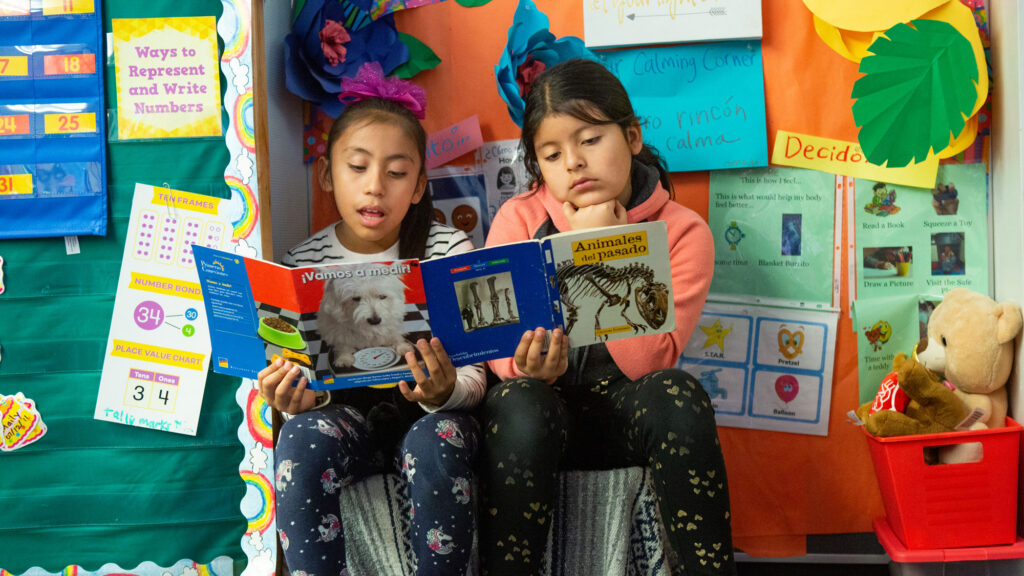
The story of the Great American Heist continues: this time, it’s robbing students of the supports they need to become skilled, engaged, and joyful readers.
In its latest chapter, the Trump administration released a budget proposal this week that has once again proposed cutting billions in federal funding for our nation’s public schools. Under the banner of flexibility, the President’s request also includes a consolidation of several federal education programs into a “Make Education Great Again” (MEGA) block grant.
Under MEGA, students would be far less likely to receive the wraparound supports that help them become strong readers.
Together, these changes don’t track with the administration’s story line that its No. 1 priority is to improve literacy outcomes. Rather than supporting students, these cuts will undermine strong literacy opportunities, particularly for students of color, students from low-income backgrounds, students with disabilities, and multilingual learners.
The proposal eliminates Comprehensive Literacy State Development grants (CLSD), asserting states can continue these initiatives through the MEGA block grant. In practice, this removes one of the only federal funding streams explicitly designed to improve literacy outcomes for students from underserved backgrounds.
CLSD explicitly directs resources to settings with high-need students, while requiring evidence-based state literacy plans, a sub-granting structure to support specific school communities, and defined reporting mechanisms. And it does so while giving states broad latitude to determine and fund activities in alignment to their own state’s literacy priorities.
In contrast, the MEGA block grant, while requiring states to put a portion of their allotments toward literacy instruction, would eliminate requirements to target funding to students from underserved backgrounds, guardrails for evidence-based literacy investments, and accountability in how funds are distributed and used.
Eliminating clear guidance and explicit signaling of expectations flies in the face of evidence from states like Mississippi, which shows that high expectations, coupled with adequate funding and fair accountability, can move the needle for students.
Bright spots, like in Washington, D.C., demonstrate how CLSD grants can support literacy gains. Given the evidence in support of literacy initiatives with clearly defined parameters — and bipartisan support for more accountability for CLSD funds — it’s clear that now is not the time to loosen guardrails on this grant program.
The 17 programs proposed for consolidation each serve distinct functions, earmarked to dismantle barriers to learning for specific students and enable stronger academic opportunities, in turn, creating the necessary conditions for literacy gains.
For example, an additional 1.2 million hours of literacy activities annually provided through after-school centers are now at risk. Locally, programs, like one in Nebraska, funded through Statewide Family Engagement Centers — which offered 34,000 hours of family engagement opportunities and distributed 73,000 books in 16 school districts — would be on the chopping block. And funding to help students experiencing homelessness get their basic needs met so that they can engage in learning, like those provided via the McKinney-Vento Homeless Assistance Act, could dry up.
What would all this amount to? In short, under MEGA, students would be far less likely to receive the wraparound supports that help them become strong readers. Funds can be redirected according to state priorities, some of which are far cries from ensuring all students have opportunities to become skilled readers.
Eliminating a dedicated funding stream for annual assessments and folding it into a flexible block grant could create openings to dilute or even potentially bypass requirements altogether. This is especially concerning as multiple states have already sought waivers to dilute their summative assessment and accountability systems. Annual summative assessments remain one of the most important data measures to understand whether students are reading at grade level and how outcomes vary across student groups. Weakening this system would significantly reduce visibility into student literacy outcomes and make it harder to identify where support is most needed.
Dedicated federal grant programs proposed for elimination support a wide variety of specific functions and student populations, often those who require unique supports with literacy.
The budget would, for example, eliminate Comprehensive Centers, which play a key role in building state and district capacity to improve outcomes, particularly those in the lowest-performing schools and with literacy-related initiatives. For example, the Comprehensive Center in New England developed tools to help Massachusetts district leaders select evidence-based literacy interventions and is co-developing a playbook for Vermont districts to implement local literacy plans.
The budget also would eliminate English Language Acquisition grants that help multilingual students receive effective instruction to become proficient in English. This is especially problematic given the link between oral language and reading skills. It would also ax support for the Institute of Museum and Library Sciences, which supports public libraries, and the Education Innovation and Research program, which supports evidence-based innovations to improve student achievement.
In the end, this story doesn’t add up. The pages are filled with changes to American education that do not help our students succeed.
Photo by Allison Shelley for EDUimages
 March 05, 2026 by Kurt Russell
 The Department of Education’s “patriotic education” is an attempt to whitewash U.S. history and suppress the truth about America’s past
 December 02, 2025 by Jinann Bitar
 CCAMPIS is the only federal program that helps low-income student-parents access child care so they can complete college. The Trump administration is sabotaging it
 October 07, 2025 by Jonathan Feinstein
 A new tool shows users how federal funding proposals would affect students in different districts