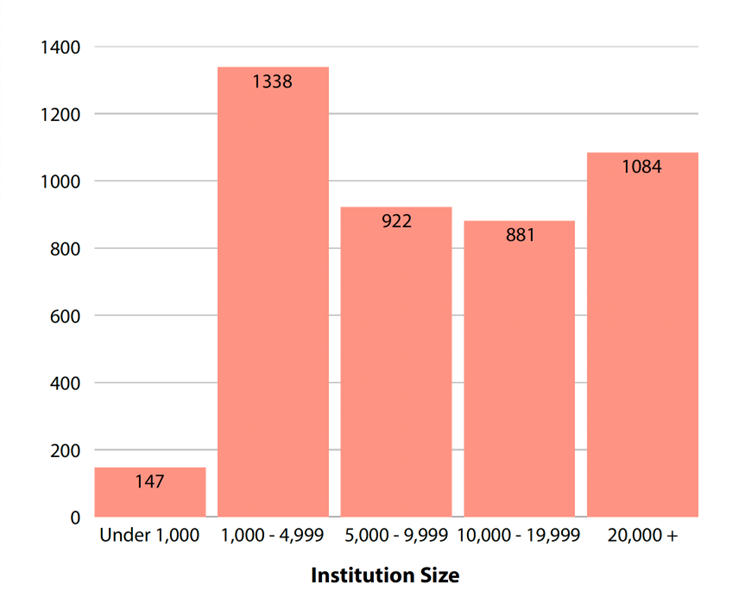
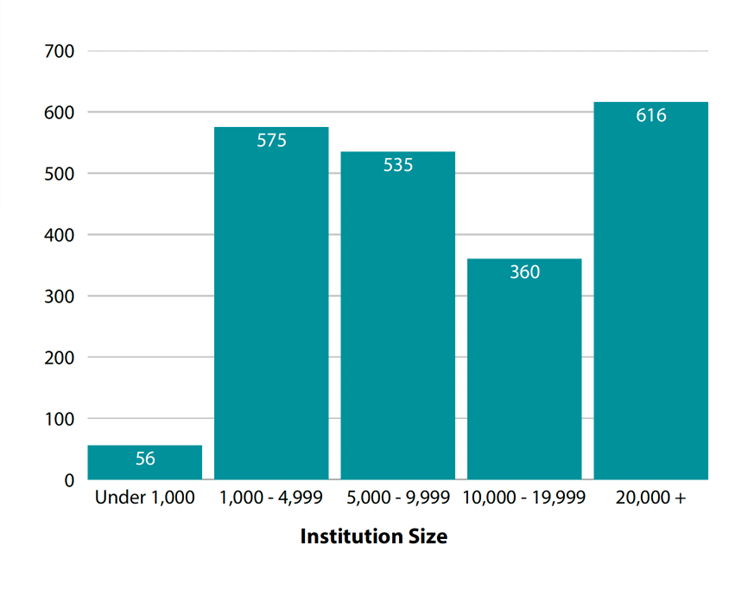
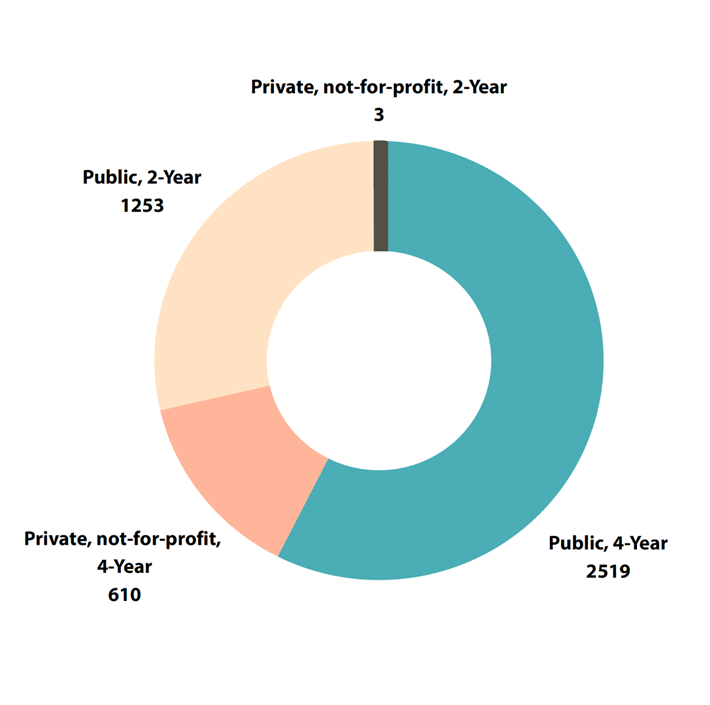
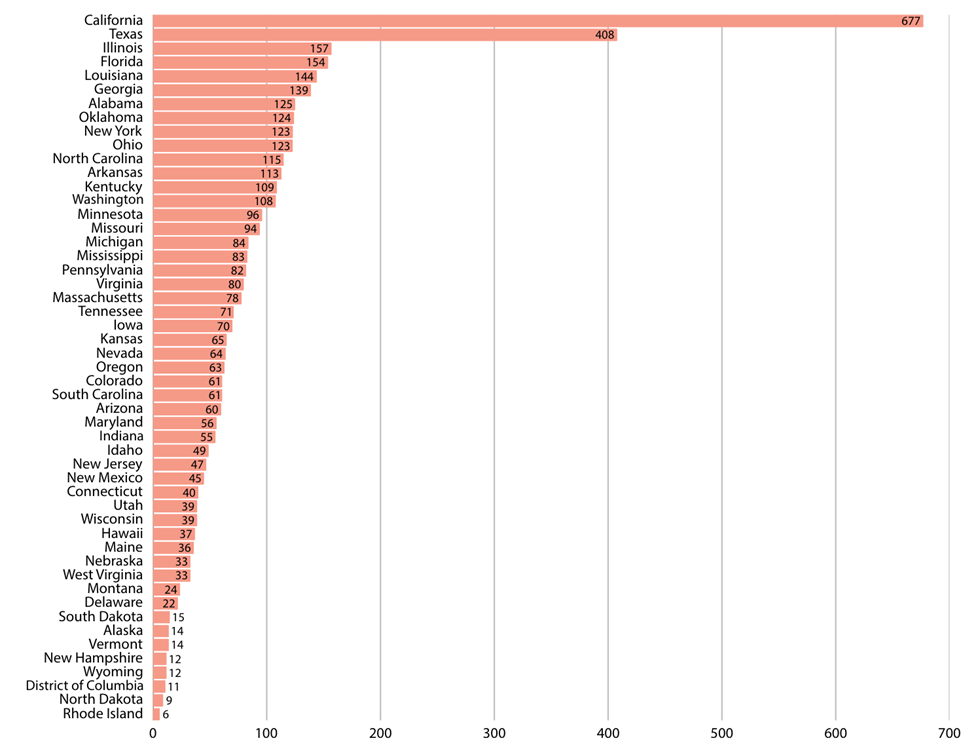
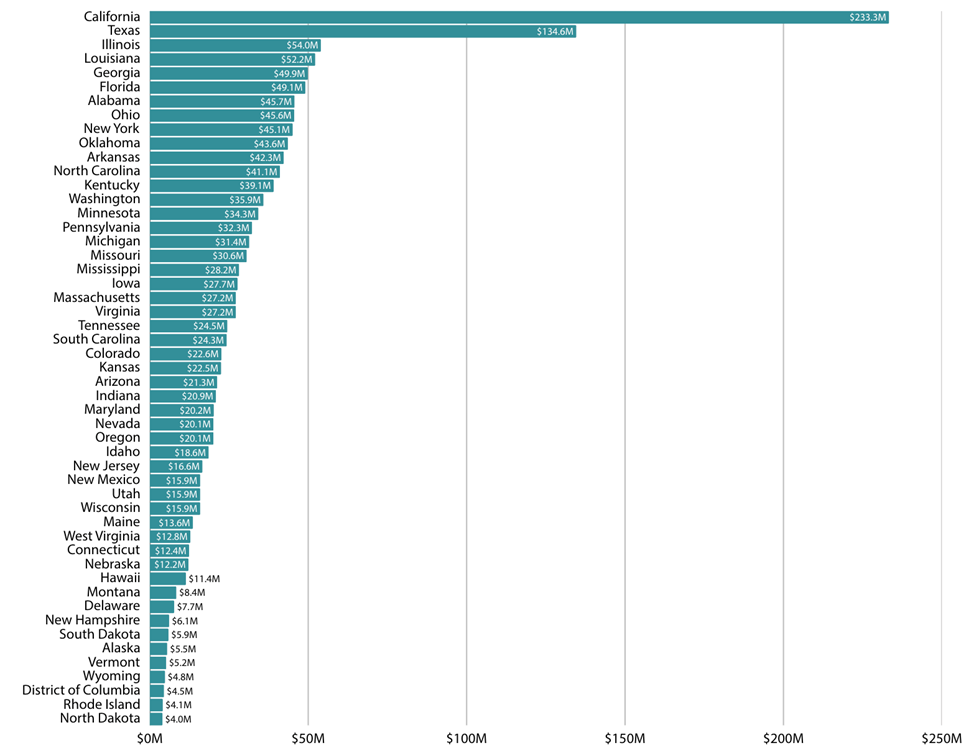
Between 2021-2024, California had the largest number of TRIO grant awards, with 677 totaling over $233 million (see Figures 4 and 5). Texas had 408 awards amounting to $132.7 million, and Florida, Illinois, and Georgia each recorded more than 130 awards and around $50 million in funding. States such as Vermont, Rhode Island, and North Dakota received fewer than 15 awards and less than $5 million. These differences reflect, in part, the size and number of eligible institutions in each state, as well as the concentration of colleges that meet TRIO’s target population criteria. For example, many Hispanic-serving institutions are concentrated in states like California, Texas, and Florida, which have large Latino populations, while many historically Black colleges and universities (HBCUs) and predominantly Black institutions (PBIs) are in Southern states with large Black populations. Overall, the distribution of awards and funding underscores how TRIO resources are spread across diverse higher education systems and student populations nationwide.
Looking Ahead: Priorities for Future Research
Additional research is needed to improve our collective understanding of how federally funded college-access programs function and their impact. Analyzing other federal initiatives, such as GEAR UP, could help us compare how different programs support students and where gaps remain.
More qualitative research that centers on the lived experiences of students is needed, too. Focus groups or interviews with former program participants could shed light on the nonacademic supports — such as mentorship and mental health services — that are often crucial to student success but overlooked in the data.
Finally, the Department of Education should release more data on these programs, and newly available public data should be used to explore what’s working and what needs to be changed. Future research should focus on which strategies lead to real outcomes, especially for first-generation and low-income students who face the greatest barriers.
Strengthening TRIO Through Data and Accountability
While completing this capstone project, I witnessed firsthand how politics are increasingly undermining the traditional role and priorities of the Department of Education. Recently, the Trump administration withheld $660 million of the $1.2 billion in funding from several TRIO programs that support students from low-income backgrounds. However, federal support for these grant programs hasn’t completely vanished, as some awards have since been released and congressional lawmakers are working on legislation to maintain funding for many of the programs affected by the decision to freeze or cancel various grants. Still, the administration’s actions threaten the stability of programs that over 650,000 students depend on each year to pursue a higher education — a pathway that remains one of the most effective drivers of social mobility. It’s essential to preserve and strengthen these programs through ongoing evaluation and public accountability.
My analysis provides a national snapshot of TRIO funding distribution across public and not-for-profit private colleges and universities. Specifically, this research examines both the number of awards and the total dollars allocated, allowing us to understand which institutions receive grants and how these resources are distributed among different types of higher education institutions. By mapping this distribution, the analysis reveals investment patterns and highlights disparities in the federal support available to students based on where they are enrolled.
However, this inquiry does not address what impact these programs have on students. To evaluate program effectiveness, researchers and federal agencies will need more comprehensive data.
Going forward, federal agencies should take the following steps:
- Make program data and evaluations public by default. The Department of Education should proactively release evaluation data, rather than only responding to individual requests.
- Invest in robust evaluation infrastructure. The Department of Education, the Government Accountability Office (GAO), and the Institute of Education Sciences (IES) should fund comprehensive research on program effectiveness.
- Expand the federal government’s analytical toolkit. Evaluation efforts should include cost-benefit analyses, equity-impact assessments, and implementation studies to gain a better understanding of both short- and long-term outcomes.
Pinpointing which interventions work best could strengthen program design, inform better practices, and help ensure that students receive the support they need to succeed. This project offered a glimpse of where TRIO funding goes but there is still more we need to understand.
TRIO programs exist to expand college opportunity for first-generation and low-income students like me. That mission remains just as important today, but with better data, smarter research, and real transparency, we can make sure TRIO lives up to its full potential and reaches every student it was meant to serve.
For more information on the distribution of TRIO funds, please see the dashboard.
Daniel Ceva recently earned a master’s degree in public administration from the University of Pennsylvania. The research highlighted in this blog is from his capstone project.
As part of our commitment to elevating diverse perspectives, EdTrust occasionally features guest blogs. The views expressed are those of the author and do not necessarily reflect EdTrust’s views or positions.
Photo by Allison Shelley/Complete College Photo Library

 December 02, 2025 by Daniel Ceva