Protecting Students While Public Education is Under Attack

This guide outlines five urgent threats posed by the federal government’s retreat from public education, along with the concrete actions advocates must press state leaders to take to counter this Great American Heist and ensure that every student can succeed

compass February 10, 2026 by EdTrust
Students at Sutton Middle School compare and contrast songs representing different eras in history during an International Baccalaureate immersion day.

Introduction

Soon after President Donald Trump took office in January 2025, his administration launched an aggressive effort to “return education to the states.” In reality, this agenda is a sweeping federal attack on public education, a part of a broader Great American Heist that shifts power, resources, and protections away from students and communities and toward political ideology and private interests.

This is not about improving schools. It is a political attack with devastating consequences for students, especially those who are traditionally underserved: students of color, students from low-income backgrounds, multilingual learners, students with disabilities, and immigrant youth.

By weakening civil rights enforcement, hollowing out funding, undermining accountability, and implementing a national voucher program, these policies strip away critical safeguards and widen opportunity gaps across states and communities.

While many of these actions have sparked legal challenges that are still moving through the courts, the push to dismantle the federal role in public education shows no signs of letting up. The threat is ongoing. The consequences are real.

In the absence of strong federal leadership, state leaders must step up. Equity advocates, policymakers, and education leaders must work together to stabilize funding, strengthen accountability, and enact policies that protect students and uphold their civil rights.

The following sections outline five urgent threats posed by the federal government’s retreat from public education, along with the concrete actions advocates must press state leaders to take to counter this Great American Heist and ensure that every student can succeed.

Photo by Allison Shelley for EDUimages

Threat 1: The Dismantling of the U.S. Department of Education

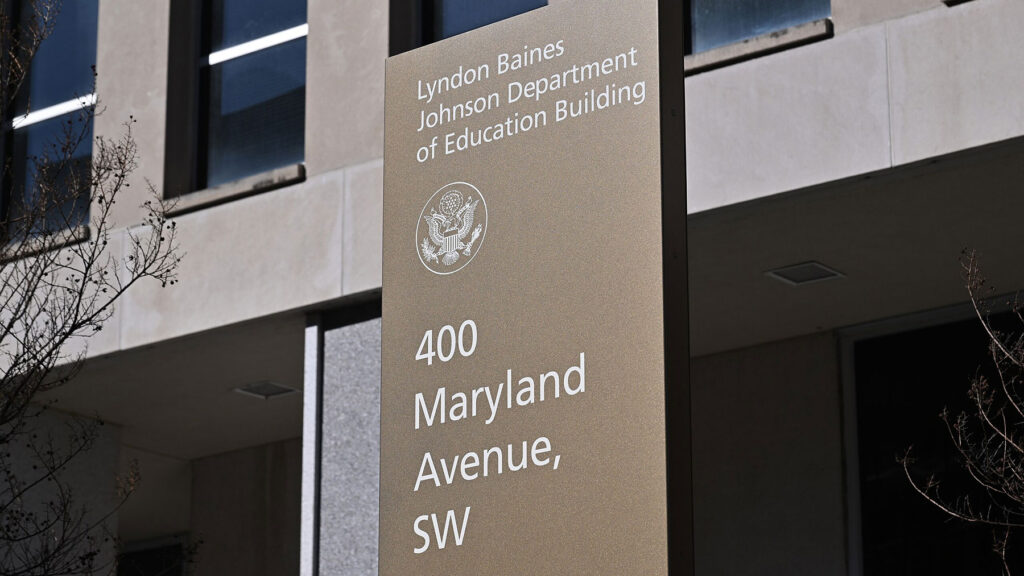
Dismantling the U.S. Department of Education (ED) has been a key strategy of the Trump administration to shirk the federal government’s responsibility to ensure all students — particularly those traditionally underserved by America’s schools — can learn in safe, supportive, and inclusive learning environments.

Without the U.S. Department of Education:

  • There is no federal oversight to ensure states hold schools accountable for collecting and reporting data on student performance or identifying and supporting struggling schools and students.[i]
  • National data on how schools are serving students, across several domains, would no longer be collected and publicly reported.[ii]
  • Programs ensuring education for migrant students or students experiencing homelessness could wane.[iii]

[i] Shoemaker DeMio, P., & James, W. (2025, August 27). Public education under threat: 4 Trump administration actions to watch in the 2025-26 school year. Center for American Progress. https://www.americanprogress.org/article/public-education-under-threat-4-trump-administration-actions-to-watch-in-the-2025-26-school-year/

[ii] Long, C. (2025, August 28). In the assault on education research, students are the victims. NEA. https://www.nea.org/nea-today/all-news-articles/assault-education-research-students-are-victims

[iii] U.S. Department of Education, “U.S. Department of Education, Fiscal Year 2026 Budget Summary.”

How State Advocates Can Drive Change

  • Lock in student protections at the state level: Press legislators to codify essential federal programs, funding streams, and civil rights protections into state law to prevent the erosion of critical student supports.
  • Defend transparency and accountability: Mobilize to ensure states preserve strong data systems and accountability measures that track student outcomes, expose inequities, and drive continuous improvement.

Download the Brief

Threat 2: Dire Cuts to Education Funding

When it comes to ensuring that all students can thrive, money matters. Research shows that increased school spending is linked to higher graduation rates, higher wages, and reduced adult poverty. Yet most state funding systems are still inequitable and provide less for students who face greater barriers to opportunity: students of color, multilingual learners, students from low-income backgrounds, students with disabilities, and students from rural areas. Nationwide, federal funds make up about 10% of all public education funding and are designed to support students and districts with more needs. If federal support shrinks or becomes less stable, state leaders must protect equitable funding formulas and ensure that students with the greatest needs receive their fair share.

RISK: Reduction of Federal Funding

Since President Trump took office in January 2025, the administration has repeatedly rescinded, withheld, or threatened to withhold crucial federal education funding previously allocated by Congress to states and districts. Though federal funding makes up a small percentage of education budgets overall, it can be a large source of funding in high-need districts. For example, federal funds make up 20% of total funding in San Antonio, Texas, and 15% of funds in Milwaukee, Wisconsin. Reduced federal funding also harms students in the South and rural areas, which rely more on federal funding than other communities. Cutting federal school funding would cause irreparable harm.

Data to Assess your own State’s Funding System

How State Advocates Can Drive Change

Defend state school funding systems to advance equity. Advocates play a key role in pushing state leaders to build funding systems that fully meet student needs and close long-standing opportunity gaps. In the face of federal rollbacks, advocates must mobilize to ensure state leaders protect and strengthen school funding systems that prioritize equity and adequacy — especially for students of color, students from low-income backgrounds, multilingual learners, students with disabilities, and students from rural areas.

Advocates should organize, build coalitions, and push lawmakers and state education leaders to:

Reform funding formulas to direct more resources to high-need districts: Demand changes that channel additional dollars to communities facing the greatest barriers to opportunity, helping close persistent funding and opportunity gaps.

Adopt student-centered, need-based funding models: Push for funding systems that allocate dollars based on the real needs of students, rather than outdated formulas that perpetuate inequities.

State leaders can and should do more to more adequately and fairly fund public schools. Too few state funding systems are investing enough funding to cover actual education costs and ensure that districts can provide enriching learning environments for all students. Additionally, many states still fall short of providing additional funding for students that are traditionally underserved by public schools. This makes it more difficult for districts and schools to boost student outcomes and close opportunity gaps. (Read more of EdTrust’s policy positions on school funding here.)

Advocates should push state legislators to:

Find or raise additional revenue. While federal funds may be reallocated or reduced, students’ needs are not decreasing. Many districts need more funding to continue supporting students, particularly those districts that lack the fiscal capacity to raise additional revenue and are facing the steepest fiscal cliffs. Advocates should work with lawmakers to increase investments in the following ways:

  • Increase state aid in funding systems by redirecting surpluses or overfunded reserves.
  • Examine the state budget to determine where else policymakers might find money for greater investments in public education and advocate for public education investments to be prioritized.
  • Adopt progressive taxes and/or reduce or eliminate unfair tax cuts that allow the wealthy to avoid paying their fair share into public systems.
    • Example: New Jersey’s Millionaires’ Tax directs revenue into public schools, reducing reliance on property taxes.

Ensure any funding cuts are fair. If federal revenue decreases substantially and funding cuts become inevitable, advocates must press state leaders to implement budget cuts in ways that do the least harm to high-need districts.

Lessons learned from the Great Recession of 2008 show that high-poverty districts faced longer-term economic harm when states indiscriminately cut public education funding, since they tend to be more reliant on state aid. Research shows that from 2009-2020, state aid-dependent districts struggled more to return to or exceed pre-recession levels of spending on a per-student basis than less state-aid dependent districts. Additionally, more state-aid-dependent districts had built up smaller financial cushions that could allow them to weather future shocks to their economies.

It is crucial that advocates help state leaders to choose the fairest approach to cutting state funding if cuts are necessary. One way is for states to prioritize providing temporary, supplemental transition grants to districts that meet all the following criteria:

  • Federal funding makes up a higher percentage of the district’s total revenue than the state average, indicating that the district serves a higher concentration of students from low-income backgrounds.
  • State revenue makes up a higher percentage of the district’s total revenue than the state average, meaning the district is more reliant on state aid to cover educational expenses.
  • The district or municipality lacks a strong, or wealthy, property tax base upon which it can levy progressive tax increases.

RISK: Federal Block Grants

As part of the broader push to dismantle federal education protections, the Trump administration has renewed efforts to convert core federal education programs into block grants. Block grants give states wide latitude to redirect federal dollars — previously targeted towards specific student groups and schools that need additional support — toward unrelated priorities. Without strong guardrails, struggling schools would have fewer resources and would deprive students — especially those in underfunded urban, rural, and suburban communities — of supports like tutoring, mental health services, after-school programs, and individualized instruction.

So far, Congress has rebuffed the administration’s budget requests to block grant many core programs, but ED has moved toward block-grant-like flexibility unilaterally through state ESSA waivers. In January 2026, ED approved Iowa’s request to consolidate state funding across four federal programs, including Title III — funding specifically intended to support English learners. This change allows Iowa to redirect these dollars to other state priorities, putting critical services and supports for English learners at risk.

This is just the beginning. Indiana, as of February 2026, has requested even broader flexibility, seeking authority to redirect funding across more programs and at both the state and district levels as well as changes to their accountability system that would limit communities’ ability to understand whether schools are adequately serving all students. And advocates expect other states will apply for similar flexibilities in the coming months — including Idaho, which plans to ask for changes to assessment requirements that would hold students to vastly different expectations. These changes would dramatically weaken federal funding and transparency protections. To stay up to date on the status of state waivers, visit essawaiverwatch.org.

Consequences for Students

Consolidating formula grants for elementary and secondary education, such as Title I funding for high-poverty schools and IDEA funding for students with disabilities, into a block grant poses three major risk for students: reduced funding, reduced targeting, and reduced accountability, all of which lead to fewer resources for the students who need them most.

  • Reduced funding: Proposals to consolidate programs into block grants are usually paired with a reduction in total funding: the logic is that block grants have more flexibility and fewer compliance requirements, so state staff won’t need to pay as much attention to how dollars are being spent. In addition, over time, block grants eliminate the connection between funding streams and specific groups of students or activities (such as students with disabilities), making it harder to track and advocate for continued funding.
  • Reduced targeting: Current proposals to consolidate federal grant programs into block grants would allow states to allocate funding in a way that aligns with their priorities, not federal law that ensures the money goes toward specific schools or students. For example, states could move funding away from serving students from low-income backgrounds, students with disabilities, or communities with concentrated poverty — which often includes rural areas.
  • Reduced accountability: A shift to block grants could reduce or eliminate requirements for data collection and reporting and evaluation. For example, states could no longer be required to report data on who a program serves or outcomes for students served by the program or report the data using consistent definitions or in a consistent format, reducing transparency and eliminating the data needed to hold leaders accountable for student results. Block grants would also likely come with fewer requirements for states to demonstrate to the Department that they’re using federal taxpayer dollars well.

How State Advocates Can Drive Change

Urge state legislators and SEAs to allocate block granted federal funds equitably and continue to supplement, not supplant existing local and state school funding. Many states already allocate additional, or supplemental, funds to districts for students who need support overcoming barriers to learning through their funding formulas. Should ED begin allocating federal title funds to states via block grants, advocates should work with their legislators and SEAs to:

  • Ensure these funds continue to support the students they currently serve. Advocates should work with states to make sure these funds are still directed to student groups such as students from low-income backgrounds and multilingual learners
  • Continue supplementing district budgets with title-allocated funds. State leaders should not replace existing state and local investments with federal block grant dollars, as such an action would reduce state leaders’ overall investment in public education.

Ensure transparency of and accountability for how education funds are allocated and spent. Advocates must urge state leaders to more clearly explain and share information about how they allocate funds to districts and to implement transparency measures that require districts to publicly report funding allocations and expenditures, ensuring that funds reach the students who need them most.

  • Example: Massachusetts’ Student Opportunity Act mandates that districts develop and report on equity plans to address funding disparities.

Ensure SEAs share timely information. The education policy landscape is constantly shifting under this administration. State education agencies (SEAs) must take a proactive approach to communicating with local education agencies (LEAs) and communities about changes to funding allocations.

  • State leaders should work with their LEAs to communicate changes to funding allocations that result from changes at the Department and prepare communities to adjust to reduced funding and the impact that these decisions will have on students of color, students from low-income backgrounds, students with disabilities, multilingual learners, and other vulnerable student populations.
  • State education agency leaders should engage their communities in decision-making processes. SEA chiefs and staff should prioritize transparency and invite all relevant stakeholders — educators, administrators, caregivers, students, and advocates — to the table to help shape their next budget and policy choices.

Download the Brief

Threat 3: Students’ Civil Rights Protections

Since the U.S. Department of Education was created, one of the federal government’s core roles has been to expand equitable access to educational opportunity. ED delivers targeted funding for students from low-income backgrounds, multilingual learners, students with disabilities, and students experiencing homelessness, and federal civil rights laws protect students — especially students of color, students with disabilities, and LGBTQ+ students — from discrimination and policies with disparate harms. The Department’s Office for Civil Rights (OCR) enforces these protections by investigating complaints, collecting and sharing civil rights data, issuing guidance, and securing remedies. Since taking office, the Trump administration has used staffing reductions, executive orders, and guidance to weaken civil rights enforcement and pressure states and districts to roll back policies designed to support protected student groups.

Risk: Delayed Justice

Students’ educational rights require active enforcement. With major reductions in OCR staffing and new administration directives, Black and Latino students, students from immigrant populations, students with disabilities, and LGBTQ+ students face a heightened risk of delayed investigations and weakened protections.  There were more than 20,000 civil rights cases pending at the beginning of the Trump administration; layoffs affecting more than half of the office have already resulted in the dismissal of tens of thousands of cases while threatening to slow enforcement for years and double caseloads.

Consequences for Students

  • Students with disabilities: Before IDEA, millions of students with disabilities were excluded from schools or denied adequate services. Without strong federal oversight, essential protections and access to services are at risk of being rolled back.
  • Students of color and other underserved groups: Recent guidance signals a shift away from OCR’s historic focus on protecting underserved students and toward prioritizing claims framed around the rights of white and Asian students.
  • Equity-focused programs and inclusive curriculum: Threats of federal funding cuts tied to certain “DEI” efforts could pressure districts to pull back initiatives that expand opportunity and could lead to book bans that limit access to inclusive materials.
  • LGBTQ+ students: The administration has narrowed Title IX interpretations to exclude protections based on sexual orientation and gender identity and has targeted transgender students, including restricting participation in sports and discouraging gender-affirming supports in schools.
  • Immigrant students: Federal actions have increased immigration enforcement activity in and around schools, fueling fear and absenteeism. Additional efforts to restrict access to education-related supports (including early childhood programs) and proposals like Project 2025’s call to overturn Plyler v. Doe raise the risk that states could attempt to charge tuition or deny enrollment to undocumented students.

How State Advocates Can Drive Change

Urge lawmakers to pass state laws that preserve and strengthen federal civil rights protections, especially where federal enforcement is weakening. This includes codifying core protections aligned to Title VI, Title IX, and IDEA to prevent discrimination based on race, gender, disability, and socioeconomic status—while explicitly protecting students based on sexual orientation and gender identity. States with existing civil rights laws should review and update them to ensure they are inclusive and enforceable.

Urge state leaders to pass laws that protect immigrant students’ right to learn safely and attend public school, regardless of immigration status. This includes prohibiting schools from requiring proof of citizenship, codifying Plyler v. Doe into state law, and adopting guardrails that prevent immigrant students from being targeted due to real or perceived status. Guardrails may include limits on information-sharing with immigration enforcement and requirements that districts develop clear protocols for responding to enforcement on or near campus.

  • Example: Illinois’ 2025 Safe Schools for All Act protects students’ right to a free public education regardless of real or perceived immigration status. (Resource: National Immigration Law Center guide to developing state legislation.)

Protect access to inclusive learning by prohibiting book bans and restrictions on representation in curriculum and instructional materials. Advocate for “Right to Read” legislation to protect librarians and teachers from civil and criminal liability for following professional development standards. These laws can prohibit removing books based on partisan, ideological, or religious disapproval, protect librarians and teachers from retaliation or discipline for complying with intellectual freedom principles, require formal policies governing library collection development and challenge procedures, and mandate that challenged books remain accessible during review processes. Many states require adoption of policies aligned with the American Library Association’s Library Bill of Rights or similar intellectual freedom principles.

  • Example: Rhode Island’s 2025 Freedom to Read Act requires school and public libraries to develop and follow clear policies about how challenges to books work and the process by which books are reviewed. The bill provides protections for librarians and reaffirms the legal standard that materials are only obscene if they have no literary, political, scientific, artistic, or educational merit.

Advocate for strengthening state civil rights statutes. Work with state leaders to allow legal recourse for practices with disparate impacts — where a neutral policy disproportionately harms students in protected groups. Push governors and state education agencies to build state capacity to replace what federal enforcement and transparency may no longer provide. Governors can convene a task force to review civil rights protections, strengthen data infrastructure, and issue recommendations for school boards and lawmakers.

Ensure data collection. SEAs should collect and publicly report key civil rights data historically supported through federal systems—including CRDC-aligned indicators and required IDEA reporting—and publish a biennial report at the school and district level alongside a resource hub on how to analyze data and address disparities.

Download the Brief

Threat 4: Disappearing Data

The U.S. Department of Education provides funding and technical assistance that helps states build and maintain statewide longitudinal data systems and strengthens the capacity of state and local data leaders to collect and report accurate information. These supports help state leaders track key measures—like school spending, access to counselors and other support staff, and graduation rates —without duplicating effort or reinventing systems from scratch.

Federal data collection and reporting requirements — including disaggregating data by race/ethnicity, disability status, and other student identities — shine a light on inequities and help identify promising practices that can be replicated. This data is essential for leaders to target resources to the students and schools with the greatest needs and ensure all students have access to high-quality learning opportunities. The administration’s efforts to dismantle ED — especially the Institute of Education Sciences (IES), the Office of Elementary and Secondary Education, and the Office for Civil Rights (OCR) — put the public’s ability to understand school performance and hold systems accountable at serious risk. Without the expertise and capacity of these offices, it may become difficult to continue collecting, validating, and reporting the data that helps communities identify inequities and determine where additional support is needed.

This includes:

  • NAEP (“the Nation’s Report Card”), the only assessment that enables state-by-state comparisons and provides a benchmark for the rigor of state assessments. Reports indicate the office administering NAEP has been reduced to only a handful of staff.
  • The Civil Rights Data Collection (CRDC), which tracks critical measures of educational opportunity — such as access to advanced coursework, educator and support staff availability, and discipline and school climate—disaggregated for students of different racial backgrounds, students with disabilities, and multilingual learners.
  • State report card support and oversight, including technical assistance and monitoring tied to ESEA requirements. Many states already struggle to present report card information in accessible ways; mass layoffs of ED employees could leave states with little guidance on best practices or compliance expectations.

How State Advocates Can Drive Change

Urge state leaders to continue collecting and reporting required data. This includes data on student enrollment, participation in federal programs, and student outcomes. The dismantling of the Department of Education does not eliminate federal education laws, and states remain responsible for meeting reporting obligations under ESSA and IDEA — including public school and district report cards.

Push state leaders to strengthen transparency. They should strategically supplement state reporting with critical data the federal government may no longer collect or publish and integrate that data into existing state report card and dashboard systems so families and communities can easily access them. State leaders should work with districts to preserve the capacity to collect and report key indicators of opportunity historically captured through the CRDC, including access to advanced coursework, discipline, attendance, graduation, and staffing supports.

Encourage state leaders to invest in and improve statewide longitudinal data systems. That way, they can better understand student experiences over time and align resources accordingly.

  • Example: Kentucky’s Center for Statistics (KYSTATS) supports a statewide data system that helps the state evaluate education and workforce outcomes for specific student groups, including young people who experienced foster care.

In just one year, the Trump administration has upended decades of carefully built infrastructure aimed at understanding, tracking, and improving the conditions in which children in the U.S. learn and thrive. Now, more than ever, is the time for state leaders to advance education research and development (R&D). Advocates can use the Alliance for Learning Innovation’s State Education R&D Framework to learn more. Education R&D must always center the needs of underserved students and reflect a vision for education that prioritizes equity.

Download the Brief

Threat 5: The Federal Voucher Tax Credit Program

The federal voucher tax credit program provides a dollar-for-dollar tax credit to individuals who donate to scholarship granting organizations (SGOs) in states that have “opted in” to the program. The credit is capped at $1,700 annually for the individual, with no limit on the total amount of tax credits provided. SGOs distribute these “donations” to families, who can use the funds for a host of qualifying expenses including tuition for private schools, books, curricular and other educational materials, tutoring, online educational resources, dual enrollment fees, afterschool programs, and more. Importantly, this means families may be able to use the program while keeping their children in public schools. Families must be within 300% of an area’s median income to receive these funds from an SGO, meaning even wealthy families living in high-income areas will be eligible to participate. (For a list of the highest income eligibility limits in each state, refer to this memo.)

By January 1st of each year, governors must decide whether their state will “opt in” to the program and if so, must provide a list of SGOs in their state that will participate. SGOs have authority to determine which expenses they will fund and scholarship eligibility beyond the income limits described above, leaving the door open for possible discrimination.

The tax credit can be claimed beginning in 2027, but Treasury has already allowed states to begin opting-in if they choose.

As of January 2026, much remains unknown about how the federal voucher program will operate. The Secretary of the Treasury has regulatory authority over the voucher program and can use the rulemaking process to decide how it will work in practice. Treasury has already issued a Request for Comment (RFC) outlining questions they hope to clarify through this process. While no formal rules have been published, this initial document indicates that Treasury will likely:

  • Prevent governors from adopting additional accountability guardrails to ensure the SGOs operating in their state are high quality
  • Not require SGOs or the federal government to report data on student achievement – making it impossible for advocates to track whether the program is serving students effectively
  • Restrict governors’ ability to ensure funds from the program are supporting public school students specifically
  • Grant governors little authority in determining which SGOs are eligible for the program by potentially forcing them to include all SGOs operating in their state that meet minimal requirements.

Risk: Decreased Funding for Public Schools

Due to this tax credit, every dollar the federal government forfeits collecting is a dollar they don’t have to spend on public education. Given the Trump administration’s repeated support for voucher programs, coupled with their continued proposed or enacted cuts to public education, it’s not a stretch to assume that the likely substantial costs associated with this program will be used to justify further attempts to cut funding for public schools. Furthermore, although vouchers are overwhelmingly utilized by students already in private schools, public schools also stand to lose money directly from any students who use the program to switch from a public to a private school.

Risk: Lack of Accountability

The legislation creating the federal voucher tax credit includes minimal accountability guardrails. While further guardrails may be implemented by Treasury through the rulemaking process, their initial RFC makes this seem unlikely. Without clear accountability guardrails, the program stands to funnel public dollars toward ineffective and unaccountable programs, most of which serve the wealthiest, while leaving those students with the greatest needs behind. Furthermore, the lack of accountability makes it difficult for the public to understand where and how their tax dollars are being spent. This makes it more likely that the program will be used to fund schools and services that have not been shown to educate students effectively, or even for expenses that are not educational.

Consequences for Students

The non-public institutions that will be supported and proliferated by this national voucher scheme are not bound by civil rights laws, not subject to public reporting requirements, not required to serve all students, and not subject to the same state level oversight as public schools. This means students — particularly Black and Latino students, and students from low-income students backgrounds — will be subject to an education system that is less safe, less welcoming, and less effective.

  • Increased discrimination. Private schools are not required to accept every student, or to provide additional services for students with disabilities. This means students with additional needs, such as multilingual learners, students with histories of behavioral problems, students with low test scores, and students with disabilities, may face increased discrimination. The racialized enforcement of school discipline policies also means that students of color are more likely to face discrimination when applying to a private school.
  • Limited school accountability. While regulations vary by state, many private schools are not required to meet the same quality and accountability standards as public schools. This lack of accountability measures imposed on private schools, or the program as it currently stands, makes it more likely that students will use funds from an SGO to attend private schools that have no proven history of educating students effectively.
  • Fewer resources for students. Even if students choose to remain in public school or not use the federal voucher tax credit all together, the diminished funding for public schools caused by the program will force them to do more with less. The loss of both federal funding and state-based per-student funding could force public schools to make tough decisions like cutting programs, increasing class sizes, or even closing schools that experience significant enrollment declines.

How State Advocates Can Drive Change

  • Encourage governors to opt-out of the federal voucher tax credit. State advocates should urge their governor to opt-out of the federal voucher program given the lack of clarity from Treasury regarding governors’ ability to shape this program to best fit the needs of their state, the demonstrated harm voucher programs pose to public schools, the discrimination they perpetuate, and their negative impacts on student achievement

Note: The feasibility of the suggestions below may shift following the release of the Treasury’s final rules for the program, which will clarify how much latitude governors have to oversee the program’s operation in their state.

In states where the political or statutory environment makes opting out untenable, state advocates can work to minimize harm by:

  • Influencing governor’s list of approved SGOs. State advocates can work to influence which SGOs the governor includes in the program to ensure only those SGOs that prioritize students with the highest needs, have stringent accountability requirements for the programs they fund, and provide funding to public schools, can participate.
  • Advocating for accountability guardrails on SGOs operating in the state. State advocates can push their state legislature to impose the strongest possible accountability and equity guardrails on SGOs operating within their state. This can include guardrails such as non-discrimination protections; clear requirements for transparency and reporting; limits on the types of expenses that qualify for scholarships; and protections for public school students who may otherwise be disadvantaged under the program.

Download the Brief