CONTACT: media@edtrust.org
More Needs. Fewer Resources. New EdTrust Report Reveals Which Students Get Shortchanged in School Funding
Districts serving the most students of color receive $1,300 less per student, while those serving the most English learners receive $900 less, according to a new EdTrust analysis of state and local school funding
WASHINGTON — The challenges facing public schools are mounting. Cuts to the social safety net, aggressive immigration enforcement, and federal education budget cuts are making the job of public schools harder, even as they work to provide the academic and social-emotional support students need to reach their full potential. Students bring extraordinary talents, aspirations, and promise into their classrooms every day, but too often, the resources available to their schools fail to match their potential or provide the support they need to thrive.
At the same time, states are not doing enough to close gaps to ensure that schools serving the most students furthest from educational opportunity (English learners, students of color, and those from low-income backgrounds) are receiving significantly more funding than schools serving students who society has already set up for success.
Today, EdTrust released “Funding for Fairness: Revenue Inequities for States’ Highest-Needs Districts,” the latest edition of a long-running analysis that finds that across the country, state and local school funding remains inequitable for students of color, English learners, and students from low-income backgrounds.
“We promise every student a fair shot to nurture their talents to the fullest, yet too many states fail to fund that promise. Adequate and equitable school funding is the key to advancing opportunity for students traditionally furthest from it, and a pillar of EdTrust’s advocacy. We should celebrate the progress we have made and continue to advocate for every student to have the right to excel and thrive through school and career,” said EdTrust President and CEO Denise Forte.
Adequate and equitable funding is the first step in a high-quality education. Supports needed for all students — access to a challenging curriculum, strong implementation of evidence-backed literacy instruction, access to career education and pathways exploration, highly-skilled educators, or supportive guidance counselors — all require strong funding. Even as enrollment shrinks, schools still must have enough funding to equitably serve their students.
Among the report’s findings:
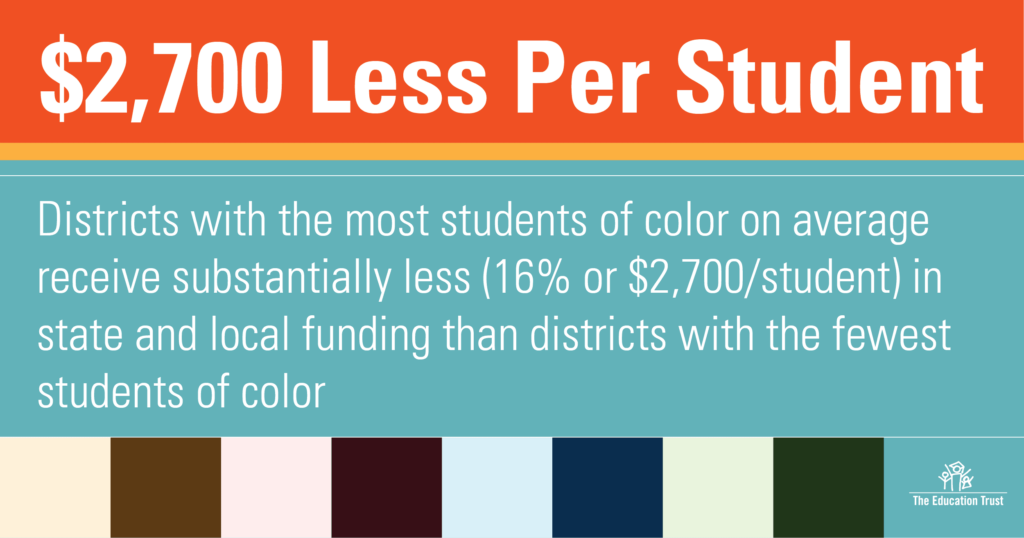
- Districts serving the most students of color receive about 7%, or $1,300, less per student than districts serving the fewest students of color.
- Districts serving the most English learners receive 5%, or about $900, less per student than districts serving the fewest English learners.
- Districts serving the most students from low-income backgrounds receive about the same as those serving the fewest students from low-income backgrounds. Although on a national average they receive about $200 more per student, this is insufficient to address all the challenges faced by students from low-income backgrounds. Additionally, 16 states still have regressive funding distributions, meaning high-poverty districts receive less than low-poverty ones.
The report and an accompanying interactive tool detail funding inequities nationally and within states. These inequities are not an accident, but a direct consequence of decades of racist policies that still devalue property held by Black families, and xenophobia that continues today in the form of efforts to limit immigrant students’ right to a public education.
“Addressing school funding is just the first step in ensuring all students have access to opportunity. We also need to create a strong social safety net that ensures equitable access to housing, health care, nutrition, and more,” said Qubilah Huddleston, equitable school funding lead at EdTrust and the report’s author.
Read more about ongoing school funding equity work from EdTrust, EdTrust-Tennessee, and Southerners for Fair School Funding. Additionally, stay tuned for EdTrust-West’s upcoming report on fair funding in California in the spring.
***
About EdTrust
EdTrust is a national nonprofit organization that advances policies and practices to dismantle the racial and economic barriers embedded in the American education system. Through research and advocacy, EdTrust changes the way public education works, and who it works for, from preschool through college.


 October 28, 2026 by EdTrust