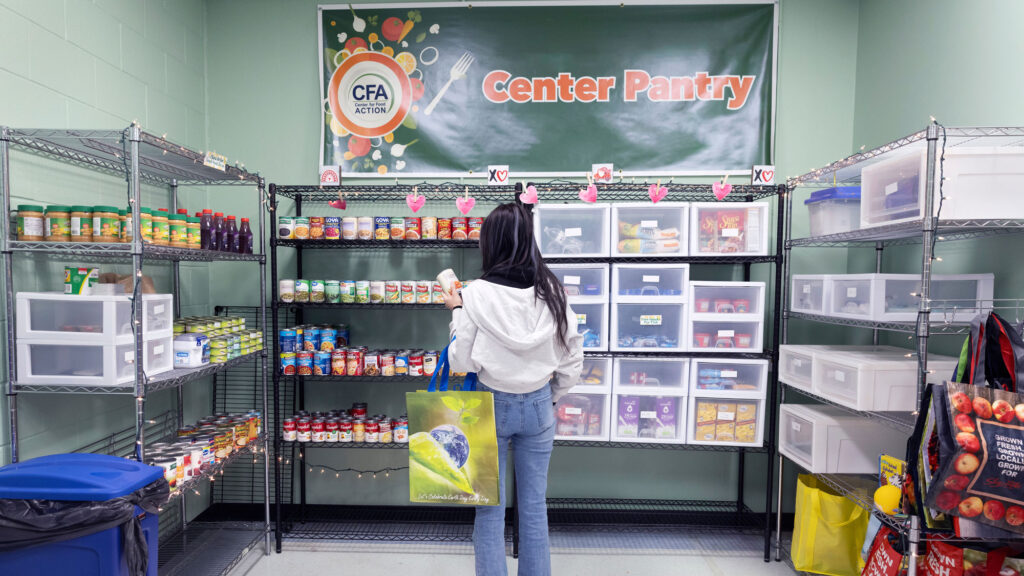
My tenure as EdTrust’s 2024-25 Andrew Nichols fellow coincided with growing threats to SNAP and Medicare, impacting nearly 42 million people nationwide, with students among the most vulnerable population. This issue is deeply personal to me, because I constantly faced hunger as a student and often found myself choosing between rent, gas, groceries, and school materials. This constant juggling act for students doesn’t just stop once they graduate either. In an increasingly unaffordable economy, it’s a harsh reality that food insecurity continues to impact young people far after they leave the classroom.
At EdTrust, I’ve had the opportunity to investigate how these systems work and to advocate for the changes needed to ensure that students don’t have to choose between surviving and succeeding.
This level of urgency and relevance fueled my drive to explore the broader issue of college affordability and students’ access to public benefits. At EdTrust, I’ve had the opportunity to investigate how these systems work and to advocate for the changes needed to ensure that students don’t have to choose between surviving and succeeding.
In 2024, EdTrust collaborated with TICAS, TSC, and SHEEO to share information on the college SNAP gap and the barriers that many students face in accessing public benefits such as SNAP. That work prompted broader questions about how state investment and policies related to basic needs fit into college affordability strategies and student success efforts. In response, EdTrust launched a pilot project focused on student basic needs and public benefits, including food assistance, healthcare, and cash assistance programs. While there has been significant research and effort dedicated to supporting students throughout their postsecondary journeys, limited access to essential needs continues to create barriers to persistence, college completion, and overall student well-being. These challenges underscore the urgency of advocacy, policies and programs that ensure students have the resources they need to complete their education.
As part of this pilot project, we conducted a mini-case study exploring five states: Washington, Pennsylvania, Hawaii, Alabama, and Illinois. We spoke with state officials, policymakers, and institutional leaders about how federal and state policies related to SNAP, Medicaid, and Temporary Cash Assistance for Needy Families (TANF) have supported their efforts to address students’ basic needs and how proposed higher education budgets shape this work.
Our Findings
Our findings revealed the importance of coalition building and partnerships both within institutions and across external organizations in advancing support for basic needs. These collaborations were especially critical for strengthening policy development, legislative advocacy, and data tracking efforts. One of our partners in Pennsylvania mentioned that “[T]his work doesn’t happen without our partners, so it is absolutely the whole goal to ultimately break down silos.” Partners in Alabama and Pennsylvania highlighted the crucial role that institutional support, state agencies, and partner organizations (e.g., Swipe Out Hunger and state food banks) play in building coordinated support networks that support students, strengthen student basic-needs initiatives, and promote long-term sustainability. However, recent changes to SNAP eligibility and cuts to benefits have increased pressure on already strained local food banks, reinforcing the need for sustained public investment and policy solutions that ensure students can meet their essential needs and remain supported through their higher education.
Another finding revealed that some of the challenges and frustrations with staffing capacity and turnover left staff feeling like they are “reinventing the wheel.” One of our Hawaii partners identified that state-level advocacy needs “to have the right people who have the appropriate level to give input to the conversation at hand… it’s finding that right composition to get the people in the room to have the conversation.”
While all states acknowledged funding challenges tied to budget cuts, delayed state allocations emerged as a key barrier to effective implementation. Although these delays were often framed as necessary to maintain fiscal stability during economic uncertainty, they frequently shifted financial uncertainty onto institutions that found it difficult to maintain sustainability for consistent, student-centered support systems. For students who relied most heavily on these services, these delays disrupted continuity of support and exposed the need for funding policies that prioritize stability and sustainability. Our Pennsylvania partner best stated it, saying, “We know that financial aid programs are the best way to get students to enroll, but what ensures and supports their persistence and completion is investing in our higher ed sector and investing in institutions.”
Recommendations
As policymakers consider the future of higher education, meeting today’s challenges will require sustained state and federal investment and a shared commitment to aligning policy priorities that advance equity, access, and affordability. To better support student success, states must:
- Improve Access to Public Service Benefits: States should advocate for expanded programming and outreach that simplifies and streamlines information about public service benefits like SNAP, Medicaid, TANF, childcare subsidies, and housing assistance. These efforts should prioritize increasing accessibility for students who need support but may be unaware of available resources. Dedicated staff, like benefits navigators, can be critical to students facing financial insecurity and to aid students in identifying, accessing, and maintaining the support they are eligible for.
- Develop Centralized Data Systems: Tracking student recipients of public benefits can help states identify gaps, refine their infrastructure, and inform more responsive policy decisions. States should strengthen cross-agency data sharing between higher education institutions, K-12, and Departments of Human Services (DHS) identify which students are accessing programs like SNAP, Medicaid, TANF, as well as where eligible students may not be receiving benefits. Improved coordination can help states identify unmet need sooner, strengthen outreach and benefits navigation efforts, and improve student retention and completion. States should also prioritize disaggregated data collection to better identify disparities and allocate resources more equitably to students with the greatest needs.
- Institutionalize Emergency Aid as a Core Student Support: States and institutions should treat emergency aid as an essential component of student success infrastructure rather than a temporary or discretionary service. Emergency aid programs must be connected to broader basic needs supports and should include sustained and flexible funding, simplified application processes, and coordinated outreach efforts that help students quickly access support during financial crises.
- Protect and Prioritize Student Services: State investment in higher education should include a sustained commitment to protecting student support services that are critical to persistence and degree attainment, particularly for students facing disproportionate barriers to college success. Services such as campus food pantries, childcare, transportation subsidies, and emergency aid are critical components of an equitable higher education system and should be sustainably funded accordingly.
- Strengthen Strategic Partnerships: Collaborations between higher education institutions, community organizations, and public agencies are not only essential for addressing students’ basic needs but also for building long-term, sustainable support systems that promote student success. Diversifying sources of support is especially critical for maintaining services to students when institutions are confronted with fiscal uncertainty.
- Expand Affordability and Access Initiatives: States should continue to pilot and refine strategies aimed at making higher education more affordable and accessible for all students, particularly those from underserved communities. This includes continuing to support high school to college pipelines, transfer pathways initiatives, and targeted outreach and enrollment.
As I continue my own educational career amidst the shifting landscape of higher education, I recognize the urgency to provide equitable opportunities for every student, regardless of their background. As federal education programs and funding are being threatened, and even eliminated, the burden will increasingly fall on states to fill the gaps. This reminds me of the importance of doing this work, not in isolation, but collaboratively, and why advocating for comprehensive student support needs to not only exist at the federal or state level, but also across higher education institutions.
My hope is that even as the education landscape continues to evolve in uncertain ways, champions for higher education can still mobilize and push for a more sustainable and collective infrastructure for our institutions to be accessible and affordable to all students, but especially the ones who have to balance their academic goals against basic survival.
The author is a former EdTrust Andrew Howard Nichols higher education research fellow.


 July 21, 2026 by Paulina Fraser