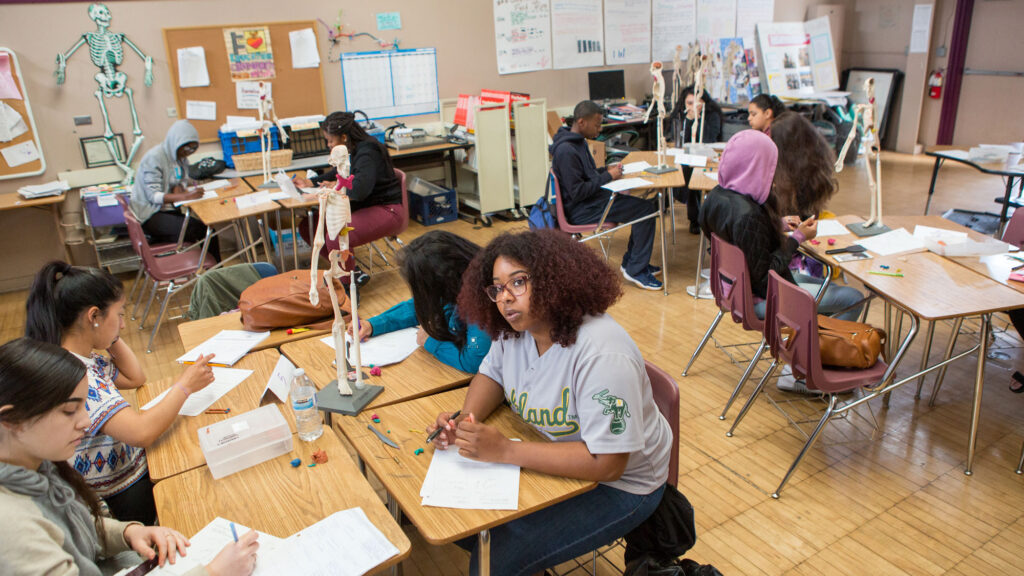
Here’s a fact that should alarm every parent, educator: thousands of middle and high school students in Massachusetts are struggling to meet grade-level literacy expectations, and too often, policymakers are ignoring the problem. This especially affects students of color, students from low-income backgrounds, dyslexic students, and multilingual students. We see it, and the signals are there — it’s about equity. While the narrative and policy focus is usually on younger readers in grades K-3, older students aren’t faring well either. Unaddressed literacy skills gaps compound and students in middle and high school need support as well.
Advocates and policymakers have devoted attention to early literacy in Massachusetts and across the country — and for good reason. Research consistently shows that reading proficiently by third grade is one of the strongest predictors of long-term success. This has fueled the “science of reading” movement, grounded in decades of evidence about how children learn to read: through explicit instruction in phonemic awareness, phonics, fluency, vocabulary, and comprehension.
But what about students beyond third grade? Middle and high school students are navigating a uniquely formative stage of development — one marked by growing independence, heightened awareness of social dynamics and peer perceptions, and an increasing ability to make choices that shape their futures. They face new academic, social, and practical demands in addition to exploration of college and career aspirations. These students must comprehend complex, grade-level texts across subjects, evaluate information from a wide range of sources, write college essays, complete job applications, and make informed decisions about their future. These examples represent only a fraction of the literacy demands adolescents navigate as they transition into adulthood. Yet far too many students are not guaranteed the instruction and support necessary to develop them.
The numbers are alarming. Even in Massachusetts — a state often lauded for high academic standards — the 2025 Massachusetts Comprehensive Assessment System (MCAS) results show that nearly half of 10th graders read below grade level, with 49% falling short of meeting expectations and 15% categorized as “Not Meeting Expectations.” These rates are even more troubling for students of color, students from low-income backgrounds, students with disabilities, and multilingual learners.
We cannot have a serious conversation in Massachusetts about graduation requirements, workforce readiness, or college access without confronting the adolescent literacy crisis. Now is the time to start building on and extending the momentum from the state’s K-3 literacy efforts.
This Literacy Crisis is Not New
The literacy crisis did not emerge overnight. It is the result of a lack of evidence-based instruction: Many students were never taught reading in ways that align with what decades of research show works best. Others were shuffled through schools where grades and graduation rates create the appearance of progress without the real skills to back it up. What’s more, new research suggests that many students who develop strong reading skills in the early grades need ongoing explicit instruction to apply these skills as texts become more complex.
This means reading no longer functions as a gateway to learning — and can become a daily source of anxiety or frustration for many middle and high schoolers. Imagine struggling to keep pace with classmates and dreading the texts others breeze through.
Parents see the impact firsthand: In statewide focus groups, families describe a troubling pattern: schools may be trying to support students, but there’s little evidence of impact: “He’s gotten A’s in language arts, but I get the feeling that almost everybody does. He skims over the words without really comprehending… I think he’s definitely a little behind some of the kids that are showing a little bit more nuance and complexity.”
Another parent said, “We didn’t really notice any improvement. We saw that her scores got better. Her report cards were better, but she would still read for a minute or two, flip the page, and storm out of the room because she’d get frustrated… they’re just grouping them by level. [N]ow she’s in a group with four other girls, and they’re all kind of at the same point where they’ll read, and then they’ll get stuck in the same places.”
These stories reveal a deeper issue: our education systems are often more adept at concealing literacy gaps and unfinished learning than confronting and resolving them. Students are passed along, report cards improve, and diplomas accumulate — while critical literacy gaps remain unresolved beneath the surface.
There are Solutions — What’s Needed is More Action
The literacy crisis cannot be solved if policymakers and school leaders refuse to confront it with practical, evidence-based solutions. But progress is possible. Initiatives like Literacy Launch and advocacy for the Right to Read bill in Massachusetts, now nearly across the finish line, prove that meaningful change can happen — but these efforts, although critical, are not enough.
If the Commonwealth is serious about equity, we must confront this crisis directly and ensure our teens are seen, supported, and taught well.
One example is Ohio, which has expanded its approach by requiring public school teachers and administrators — including high school content teachers — to receive training in the science of reading. These efforts recognize a fundamental truth: literacy is not just the responsibility of early-grade teachers. It is a shared obligation across the entire education system. Massachusetts must meet this moment with urgency, and it must start now. Here are three recommendations state leaders and lawmakers should consider in tackling the adolescent literacy crisis:
(1) Provide guidance to help district and school leaders redesign school schedules to meet students’ needs
Current middle and high school schedules often do not leave room for intervention, and teachers often lack the necessary time, systems, and specialized training to deliver targeted literacy support. State resources and guidance can help school leaders repurpose existing time blocks or make room in the schedule, such as via flex periods, to provide targeted reading support without sacrificing core instruction. States and districts can form partnerships with community-based organizations to expand access to high-impact tutoring and literacy support within students’ communities.
(2) Invest at the scale this crisis demands
Massachusetts has taken an important step with initiatives such as Literacy PRISM III grants, which support districts seeking to improve literacy in grades 4-12. However, with only a small number of districts funded, this program is not an adequate solution to reach every student. The state should expand and sustain funding streams dedicated to adolescent literacy so that every district has the resources to act.
(3) Empower every teacher to teach literacy
Adolescent literacy must be a shared responsibility across a school, and yet most secondary teachers have not been trained to support struggling readers or understand how to best support their students’ literacy development in their practice. Massachusetts should invest in high-quality, ongoing professional development across all content areas, ensuring every teacher has the basic tools to integrate literacy strategies into daily instruction. This isn’t about turning every teacher into a reading specialist; it’s about making literacy a shared, schoolwide responsibility.
There is no longer any doubt that this literacy problem exists. The evidence, stories, and solutions are right in front of us. What’s missing is the collective will to act on the scale this crisis demands. Literacy is more than a skill; it is a lifeline. Yet too many adolescents are being left without one — facing a future in which literacy and the opportunities it brings are reserved for some, not all.
Photo by Allison Shelley for EDUimages


 June 04, 2026 by Genesis Carela