During an appearance on CNN’s State of the Union this week, U.S. Department of Education Secretary Linda McMahon said that elementary school isn’t too early to sort students toward careers in the skilled trades. The research of developmental science says otherwise, and so does our nation’s ugly history of tracking, a practice that groups students based on their ability, which only has served to reflect the racial and class inequalities of American society and helped perpetuate them. Tracking at any age is problematic, but starting even younger can be especially harmful.
Skilled trades are legitimate, often well-compensated careers and a worthy target for college and career success. However, the idea that a student’s “actual skill set” can be fully known when they are in elementary school, or that any child in grade school should be placed on a specific career pathway is absurd.
The science is clear: our brains undergo rapid development during elementary school and continue to develop throughout life. What looks like an eight-year-old’s aptitude is not their ceiling; it’s a snapshot of cognitive development still in progress, shaped by instructional quality and whether a child has a safe and supportive learning environment. And as any parent knows, it is developmentally appropriate for a child’s interests to continue to change as they learn more about the world and themselves.
Skilled trades are legitimate, often well-compensated careers and a worthy target for college and career success. However, the idea that a student’s “actual skill set” can be fully known when they are in elementary school, or that any child in grade school should be placed on a specific career pathway is absurd.
Following Secretary McMahon’s approach would create an incentive for schools to stop investing equally in building every student’s foundational skills or providing meaningful career exploration. The resulting gaps could be mistaken for students landing on the pathway they were always suited for, instead of what it really is — tracking students based on who they are and assumptions about what they can become. That is especially true considering that districts serving more students of color and students from low-income backgrounds routinely receive fewer resources, despite having greater needs. In effect, sorting elementary students by “ability” would be sorting our youngest learners by resources.
If we truly want to set elementary students on paths toward their future success, we must invest in the development of their foundational literacy and numeracy skills, their interests and skills, and exploration of diverse educational, career, and civic opportunities.
When students do not receive timely, aligned instruction and supports in English Language Arts and math, the consequences for their long-term trajectories are significant and compounding. Students who are not yet proficient in reading by third grade are at a higher risk of falling behind across all subjects and not graduating high school on time. This has serious consequences for their participation in any career pathway, including the skilled trades, where just over half of workers now hold some form of postsecondary credential, a share projected to keep climbing.
Similarly, without strong elementary preparation, later access to advanced coursework, particularly in math and science, is symbolic at best. A student can’t succeed in AP Calculus if the on-ramp to eighth grade Algebra I was never built. Access to advanced coursework can’t run exclusively through gifted and talented programs. Tracking has a long and painful history in this country, and the pattern holds: students sorted early rarely move off the track they were placed on, and that sorting has fallen disproportionately on students of color and low-income students. Data shows that when given the opportunity, Black and Latino students succeed in eighth grade Algebra I at rates proportional to their peers when given the chance to participate. Rigorous learning opportunities and the necessary support to succeed must be in reach for all students.
Career exploration is valuable when done well: it connects classroom learning to the real world and builds toward college and career aspirations. But sequence and quality matter. Research shows that intentional guidance and exploration beginning in middle school helps kids avoid foreclosing career options for themselves. From there, as students navigate high school and beyond, school counselors and college and career navigators play a valuable role in helping them further explore what interests them and how to get there, without closing off any paths too soon. In other words, elementary school is too soon to be predicting students’ futures.
Secretary McMahon closed her interview by saying, “This can’t be directed from Washington, D.C.” But the federal government’s role has never been about directing every classroom decision. The Department of Education’s duty is about setting a baseline — a floor beneath which no student’s education is allowed to fall, regardless of where they were born or who they are. Removing that floor doesn’t hand power back to states; it removes guardrails for students.
Now more than ever, federal civil rights data collection is necessary to ensure schools are actually providing every student equitable access to a high-quality education, and to pinpoint areas for improvement. The Department of Education collects this data specifically to ensure civil rights compliance; yet the 2023-24 collection, which was due out by December 2025, still hasn’t been released. While disparate impact liability enables crucial enforcement when policies produce unequal outcomes for certain groups of students, federal agencies are moving to rescind this exact lever. Without these tools, a further retreat to an educational system that limits a student’s trajectory by their race, background, or income, is not far off.
A student’s path shouldn’t be chosen for them, whether by harmful tracking or inadequate school funding. Every student deserves access to a high-quality education, so they have a real opportunity to determine their futures for themselves. Such an education is not only a valuable gateway to economic opportunity and civic participation, but also a fundamental civil right —- one that cannot be reserved for some students while limiting others, especially when the sky could — and should — be anyone’s limit.
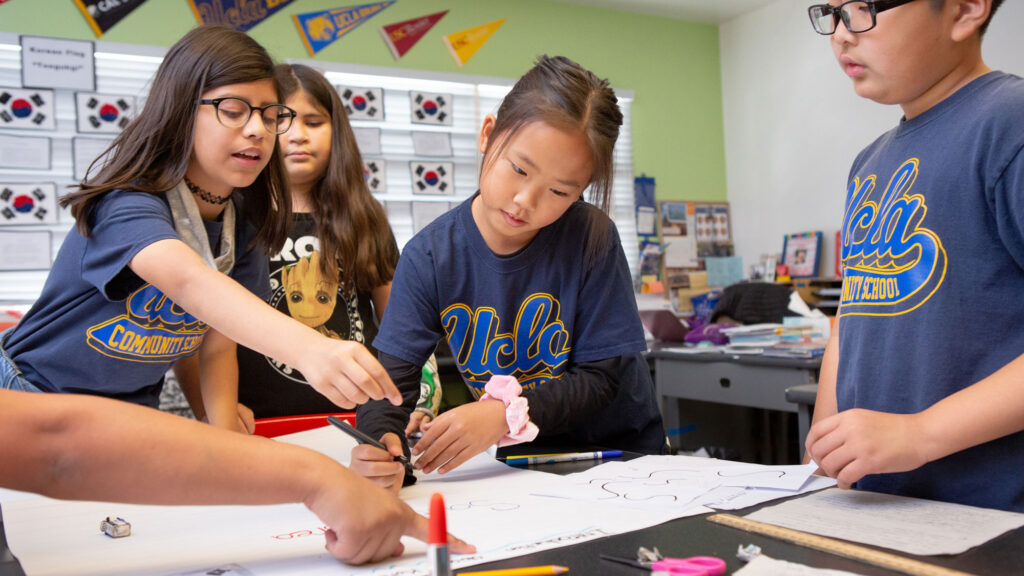
Photo by Allison Shelley for EDUimages


 August 26, 2026 by Aileen Ma