

Funding for Fairness: Revenue Inequities for States’ Highest-Need Districts
Districts serving mostly students from low-income backgrounds, students of color, and English learners are still not getting their fair share compared to other districts


Districts serving mostly students from low-income backgrounds, students of color, and English learners are still not getting their fair share compared to other districts

The U.S. spent nearly $1 trillion on public schools in fiscal year 2024, but this figure masks how school funding is inequitably distributed and not sufficiently aligned to students’ needs. Several states have made strides to better align their funding systems with student needs by adopting weighted student funding formulas that provide more funding for students from low-income backgrounds, multilingual learners, students with disabilities, and students from rural communities. Still, few funding formulas provide substantially more funding for these students, making it harder for districts to provide the resources the most vulnerable students need for success in school and later in life.
This report is the latest edition of EdTrust’s Funding Gaps analysis. This analysis looks at total state and local school funding gaps between districts serving the most and fewest students with the following characteristics: students from low-income backgrounds, English learners, and students of color.
The analysis shows that at the national level, high-poverty districts receive nearly the same amount of funding as low-poverty districts. While equal is not good enough, this is progress and better than what we found for districts serving mostly students of color and English learners. Nationally, states are providing substantially less funding, per-student, to districts with the most students of color and English learners. This can add up to millions of dollars that district leaders need to better recruit and retain experienced educators in the hardest-to-staff schools and positions, hire literacy coaches to provide evidence-based reading practices to support struggling readers, or broaden access to dual enrollment programs for students who are denied access and have historically been left out of those advanced coursework opportunities.
At the state level, one-third of states in our analysis provide less funding to districts serving the most students of color, and nearly half underfund districts serving the most English learners. By contrast, more than two-thirds of states provide equal or more funding to high-poverty districts.
This report is accompanied by our interactive tool, The State of Funding Equity. It helps advocates see the big picture of school funding gaps nationally and within states and ground them in the state of funding equity in the nation’s public education system. While it does not break down specific funding streams or track how districts spend dollars, it is a tool that advocates can use to push for fairer school funding within their states. Advocates can use this tool to:
Districts in the 2026-27 school year are facing mounting fiscal pressure and uncertainty due to numerous factors: revenue loss from enrollment declines, inflation, the unfettered growth of private school voucher programs, and cuts to key federal K-12 funding streams. As such, state and local advocates must be even more equipped with the right information and data in their fight for adequate and equitable school funding. Advocates can use this tool to push state leaders to provide enough funding so that all students can access high-quality schools, no matter if they are in a major city or rural town. Finally, as children and families are losing key social services in healthcare, housing, and food security, fair funding advocates should amplify calls to protect the social safety net so all students can come to school ready to learn every day.
Photo by Allison Shelley/The Verbatim Agency for EDUimages
Since the release of EdTrust’s 2022 report, Equal is Not Good Enough, state and local funding gaps across the nation have improved, and many states have made meaningful progress in narrowing funding disparities between districts. Some of these gains reflect important policy choices, including increased state investments and a shift toward student-centered funding formulas that target money to students with the greatest needs. States have also strengthened accountability systems, placing greater emphasis on ensuring that districts use resources in ways that improve student outcomes. While this progress is encouraging, gaps have not closed completely, and historically underserved students continue to face significant barriers to learning. The schools that they attend still need substantially greater investments to provide the educational opportunities and supports students deserve.
Nationally, districts serving the most students of color receive less state and local funding than districts serving the fewest students of color. On average, districts serving the most students of color receive 7% less state and local funding — about $1,300 less per student.
This finding aligns with a 2025 study showing that school finance reforms between 1990 and 2017 have helped close funding gaps between low- and high-poverty districts but did little to address racial inequities in school funding. On the one hand, those reforms were not designed to overtly address racial funding disparities. Yet, given the legacy of housing policies that have shaped the property wealth gap between white communities and communities of color, the lack of legal and policy mechanisms to allocate money to address the barriers students of color face is worth noting (See “The Property Tax Penalty Facing Black Students” below).
State school funding systems often leave behind districts serving the most students of color. In 17 states, these districts receive less state and local funding than districts serving the fewest students of color. In 18 states, these districts receive about the same level of funding. However, it is not enough given the persistent opportunity gaps students of color face such as not having access to high-quality instructional materials and rigorous math coursework, lacking sufficient access to literacy coaches who help improve how educators teach students to read and write, and receiving harsher discipline — even for similar behavioral issues as white students. Only eight states (Delaware, California, Louisiana, New Mexico, Minnesota, Missouri, Kentucky, and South Carolina) districts serving the most students of color receive more funding.
Racial inequities in school funding are not accidental. They are the result of decades of policy decisions. Because nearly half of all public education funding comes from local property taxes, communities with lower property values cannot raise as much money. Communities of color — especially Black communities — often cannot raise as much money as white communities due to the legacy of racist and discriminatory housing policies and practices. Redlining, restrictive covenants, and racist zoning policies have shaped the deep property wealth divides between white communities and communities of color. Today, Black homeowners still face systemic barriers that lead to their homes being valued lower than those of white homeowners, resulting in less revenue to support their local schools. And while most state funding systems have mechanisms to counteract inequities in local revenue, they are often insufficient to fully do so.
In a 2021 study, researchers estimated that in 2018, a Black student in Connecticut — a state that disproportionately relies on local revenue to fund schools — received an average of $4,300 less in local property tax revenue than a white student. This disparity is driven in large part by lower home appraisals in Black communities. Even homes in high-income Black neighborhoods are vulnerable to lower appraisals, illustrating that money alone does not shield Black communities from the effects of structural racism.
Nationally, districts serving the most students from low-income backgrounds receive about the same state and local funding as districts serving the fewest. On average, districts with the most economically disadvantaged students receive just 1% more state and local funding than those serving the fewest. That is just $200 more per student, even though research shows that students from low-income backgrounds need significantly more resources to support learning, in part, because their basic needs — such as nutritious food, stable housing, and access to healthcare — are not consistently met. When a district primarily serves students from low-income backgrounds, concentrated poverty intensifies students’ needs, yet most state funding systems fall short of providing high-poverty districts with substantially more resources.
While national data suggests some progress in funding gaps for students from low-income backgrounds, that progress varies at the state level. In 12 states, state and local funding is progressive, meaning high‑poverty districts receive at least 10% more state and local funding. In another 18 states, high‑poverty districts receive nearly the same amount of funding as districts serving the fewest students from low-income backgrounds. In the remaining 16 states, funding is regressive, meaning high‑poverty districts receive less funding.
Many students from low-income backgrounds enter the classroom having had fewer early learning experiences, which can contribute to achievement gaps seen in later grades. Research shows that students from low-income backgrounds also often have fewer quality learning opportunities at home, in school, after school, and in their neighborhoods. Over time, these unequal learning opportunities add up, impacting whether students complete high school, earn a college degree, and how much income they earn as adults. This is why high-poverty districts and schools need substantially more resources to help their students succeed.
National research shows that when schools have more funding, students do better — both during K-12 and later in life. These dollars matter even more for students from low-income backgrounds who have historically had fewer resources. State-level research shows similar results. A study of California’s funding system found that more funding, and in particular, additional funding targeted at specific students based on their needs, led to gains in student outcomes. The study found that more equitable funding increased students’ likelihood of graduating, with even larger gains for Black students. The study also found that targeted funding increases reduced the likelihood that Black 10th graders were suspended or expelled, which is important given persistent racial disparities in school discipline outcomes.
Nationally, districts serving the most English learners receive less state and local funding than districts serving the fewest English learners. On average, districts with the highest shares of English learners receive 5% less funding, which is about $900 less per student. This gap leaves districts with too few dollars to hire enough bilingual educators, deliver quality instruction in English as a second language (ESL), and provide meaningful multilingual family engagement.
Across states, funding patterns for districts serving the most English learners are mostly regressive. In 20 states, districts serving the most English learners receive less state and local funding than districts serving the fewest. In 13 states, districts serving the most English learners receive roughly equal funding compared to districts serving the fewest. Only districts in nine states (California, Colorado, Delaware, Kentucky, Maine, Minnesota, Missouri, New Mexico, and Utah), serving the most English learners receive more funding.
English learners are one of the fastest growing student populations in public schools. Research suggests that English learners need about twice the amount of funding as students who are not English learners to achieve meaningful academic progress. Yet, many state funding systems do not allocate enough additional funding for English learners. For example, despite Texas having one of the largest English learner populations, the funding system only provides 10% more funding for English learners than students who are native English speakers.
Another factor influencing how states support English learners is how state education agencies (SEAs) identify those students for language learning services. Investigations by the Department of Education and Department of Justice found that several states, such as New Jersey and New Hampshire, under-identified students who needed English language services. The investigations also exposed issues with some states inadequately assessing English learner student progress. For example, in California, the state removed students from English learner status before they were proficient, cutting those students off from needed services.
These examples of funding and policy gaps shape how well districts provide English learners with high-quality educational opportunities.
Immigrant students — many of whom are English learners — are facing growing attacks on their right to a public education. These attacks make it harder for English learners, regardless of where they were born, to get the opportunities they need and deserve. In Tennessee, policymakers have repeatedly pushed bills that would challenge immigrant students’ rights to attend public schools.
At the federal level, the Trump administration, which has led the nationwide anti-immigrant agenda, has repeatedly proposed eliminating Title III (of the Elementary and Secondary Education Act) — the primary federal program that states and districts rely on to support English learners and immigrant students — in the 2026 and 2027 budgets .
Consistent with this approach, the Department of Education (ED) eliminated the Office of English Language Acquisition (OELA), which administered federal funding and programs for millions of English learners, and approved waivers in states like Louisiana that block grant Title III funds with other title funds instead of directing those funds specifically to the needs of English learners. For decades, OELA has played a critical role in implementing and supporting Title III and providing guidance, oversight, and technical assistance to states and districts serving English learners. Functions carried out by OELA are not discretionary — they are essential to fulfilling ED’s statutory responsibilities to language instruction, educational equity, and civil rights protections. Although ED has transferred program duties elsewhere, these actions collectively seek to deny English learners equal access to a quality public education.
These continual attacks against immigrants are also creating new barriers and multiplying the needs of English learners and students from immigrant families. As federal funding disappears, districts serving high percentages of English learners will likely be forced to scale back programs and services for students that are already not receiving adequate support. State leaders must protect and strengthen school funding systems to ensure that English learners and immigrant children have what they need to succeed alongside their peers.
As this analysis shows, current funding systems leave behind students of color, students from low-income backgrounds, and English learners. All students can learn to read well and excel in math. Yet, inequities in both how much funding districts receive and the allocation of resources across schools prevents many students from reaching their full potential. As a result, millions of students are denied access to the teachers, coursework, and college and career pathways that promote success in the classroom and after graduation. State and district leaders have a responsibility to change this reality.
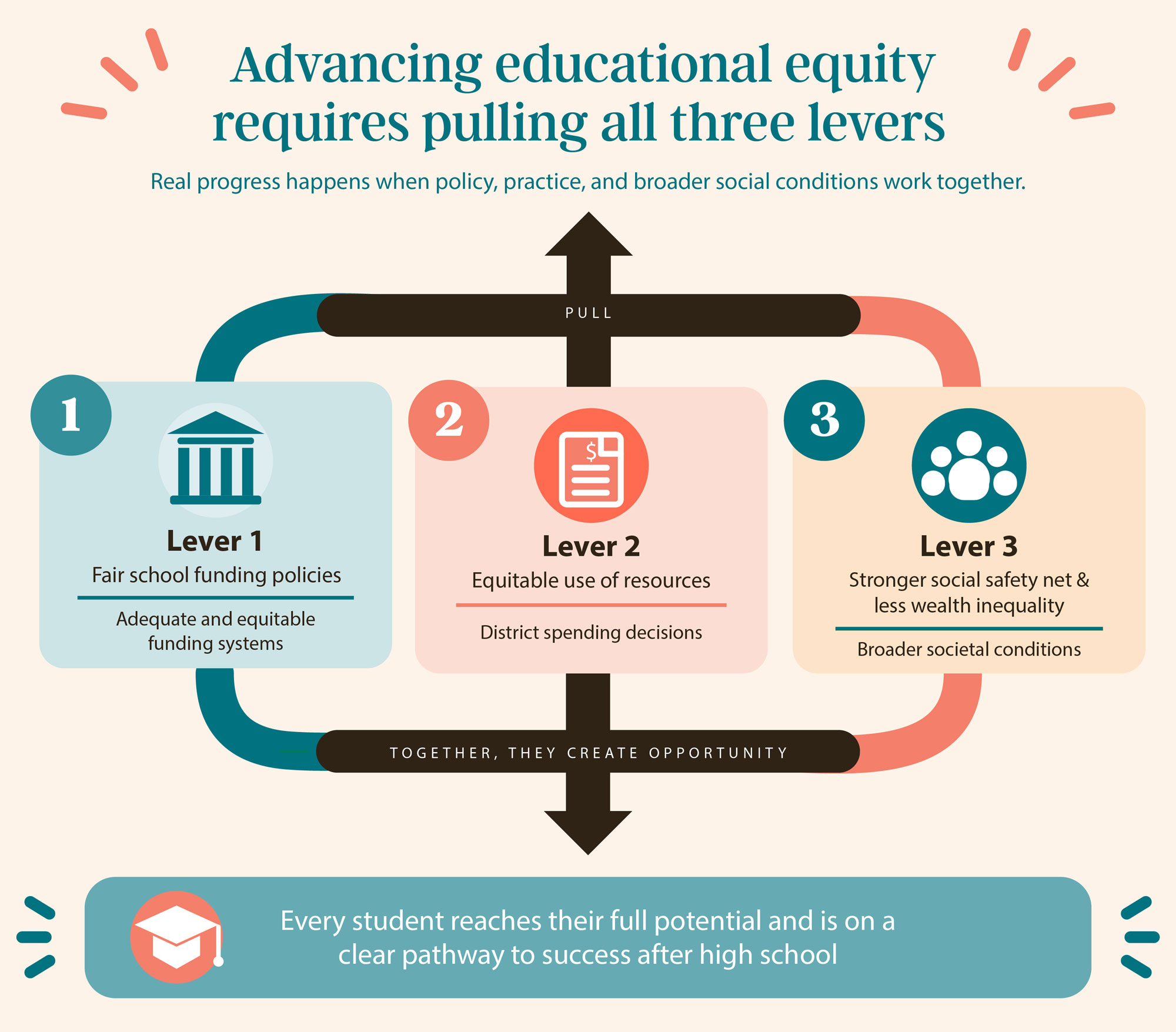
The fight for fairer school funding and high-quality learning for all students requires several steps. First, advocates must fight for key school funding policy changes that lead to fairer and adequate public investments in education. Second, advocates must also push district leaders to use those funds in ways that give every student access to high-quality learning experiences. Third, as advocates push for fairer school funding systems, they should also make clear that fair and equitable school funding is necessary, but not sufficient on its own. Broader social policies that narrow wealth, income, and opportunity gaps must also be part of the strategy to improve student outcomes.
There are five things EdTrust believes state leaders should do can create fair funding systems and reduce funding gaps between districts serving students with the most needs and those serving students with the fewest. We believe that state leaders should:
To learn more about what these policies look like in practice and how advocates can advance these positions in their state, read EdTrust’s Policy Positions on School Funding.
Fair school funding is not just about how much state funding systems allocate to districts. It also requires district leaders to spend the money they receive well and target additional resources for students who need them the most. Students within the same district often experience different realities and have different levels of access to certain resources. For example, nationally, Black students are more likely to attend schools with high percentages of inexperienced, first-year, and uncredentialed teachers. This matters because students taught by more experienced educators tend to achieve better outcomes. For example, a 2017 study found that middle schools students taught by more experienced educators attained higher test scores and had fewer absences from school.
Advocates have an important role to play in helping shape how district leaders allocate funding to ensure that all students have access to experienced and effective educators and positive school climates to become strong readers and capable mathematicians, and advanced coursework and meaningful career and college pathway opportunities.
The Alliance for Resource Equity (ARE) offers a suite of tools designed to support advocates in engaging district leaders in conversations about how to equitably allocate and target resources across schools.
 Schools need money, but how leaders use that funding matters, too. Resource equity is a collaborative, joint effort in which everyone from superintendents who lead strategic plans to state leaders who set policies to the advocates who fight for change all have an important role to play.
The Alliance for Resource Equity (ARE) offers a suite of tools designed to support advocates in engaging district leaders in conversations about how to equitably allocate and target resources across schools.
Part of the challenge districts and schools face today is the continued expansion of their role beyond traditional notions of schooling. Districts have stepped up to meet students’ and families’ needs that are inadequately addressed by social policy failures at the state and federal levels. Massive wealth and income inequality and a weak social safety net mean that millions of students from low-income backgrounds, students of color, English learners, and students with disabilities are forced to overcome barriers created by inequities far beyond the classroom. Districts have been left to address these challenges even though root causes of the barriers students face lie largely outside of the education system’s control.
As advocates press on for more adequate and equitable funding formulas and more equitable spending at the district level, EdTrust encourages advocates to also take a stand against policies and laws — such as the massive federal cuts to Medicaid and SNAP — that undermine the well-being of families and students.
Fair funding looks different across states, but the goal is the same: ensuring students have access to the resources they need to succeed. This section connects EdTrust’s national analysis with the state and regional work led by EdTrust-West, EdTrust-Tennessee, coalition partners across the South and the Alliance for Resource Equity.
Fair funding is about what students experience. California’s Local Control Funding Formula was built on an important principle: students with greater needs should receive additional resources. But there’s still more to be done before it truly drives equitable student outcomes as intended.
Ten years after California adopted its school funding formula, EdTrust-West’s report More to Be Done looked back on its effects, finding that unless policymakers fix the formula’s weaknesses, it will continue to fall short of its goal to close equity gaps.
Next spring, EdTrust-West will release new research examining school funding equity in California, including how resources are distributed and what California needs to create to deliver on the promise of equitable funding.
A funding formula can only respond to students’ needs when it accurately identifies those needs.
EdTrust-Tennessee’s report The Undercount shows how Tennessee’s current definition of economic disadvantage can leave students experiencing financial hardship out of the count and leave schools without resources to support those students’ needs. Shaped by community voices across Tennessee, The Undercount encouraged the state to study how it identifies students from low-income backgrounds and recommended improvements to the state legislature.
EdTrust-Tennessee also works across the region through Southerners for Fair School Funding, an initiative that supports advocates and organizations across the South working to build fairer, more adequate school funding systems.
Explore The Undercount and learn how Tennessee can better identify students’ needs and direct resources where they are most needed. Visit Southerners for Fair School Funding to see how advocates are advancing fair funding across the South.

 October 28, 2026 by EdTrust
Understanding where funding gaps persist in your state is the first step toward holding leaders accountable for shortchanging students. Use this tool to explore EdTrust’s latest analysis of school funding equity across the country

 October 28, 2026 by EdTrust
This is a glossary of terms that are used in the funding gaps report and data tool
October 28, 2026 by EdTrust This technical appendix describes the data sources and methodology in detail of the Funding Gaps 2026 report