As a first-generation college student, I know firsthand that completing the Free Application for Federal Student Aid, or FAFSA, can be both challenging and deeply consequential. The unfamiliar questions, terminology, and online system can make an already complicated college application process feel even more overwhelming to a young person. Yet completing the FAFSA can unlock the financial support that makes postsecondary education possible.
My colleague, Charlotte Pierce and I are also former college advisers. We are all too familiar with the challenges students and families face while navigating college applications and financial aid. Students should not have to navigate this process alone. Every student deserves access to the information, resources, and individualized assistance needed to successfully complete the FAFSA and understand their financial options.
FAFSA Season is Here
In the college access community, the release of the FAFSA is sometimes treated like a national holiday — and for good reason. The 2027-28 FAFSA is now available for students planning to attend college or another eligible postsecondary program during the next academic year.
A few things to know about filling out the FAFSA:
- Students do not need to know exactly where or even whether they plan to enroll before completing the form. They can submit the FAFSA before applying to or being accepted by a college.
- Parents complete their own part of the form. If a student is considered dependent, a parent must create a StudentAid.gov account and complete their section before the student can submit.
- This information is kept secure and only used when needed. The Federal Student Aid office only uses the information to compile a financial aid package.
- Colleges will only have access to a students’ FAFSA information once they’re admitted to the institution
- Completing the FAFSA early gives students and families more time to address questions, make corrections, and prepare for state and institutional priority deadlines.
- Most importantly, completing the FAFSA keeps students’ financial options open.
The FAFSA is the gateway to major forms of federal and state financial aid, including the federal Pell Grant, the Michigan Achievement Scholarship, the Community College Guarantee, and Michigan Reconnect. Although submitting the form does not guarantee institutional aid, students generally cannot access these resources without completing it.
To maximize the benefits of a completed FAFSA, the state of Michigan has invested $10 million to help districts increase completion rates. The Universal FAFSA Challenge Grant supports districts incorporating a FAFSA graduation requirement and implementing FAFSA completion support. The grant can be used to support college access staff, professional development, and events like FAFSA completion nights.
The FAFSA has also introduced new financial aid opportunities for students and adult learners pursuing the workforce: an expansion of federal Pell Grants now includes short-term, career-focused postsecondary programs, commonly referred to as Workforce Pell. While the federal government has implemented basic guardrails, program eligibility is largely determined at the state level. Michigan is currently in the process of reviewing applications to determine program eligibility, and the Michigan Department of Labor & Economic Opportunity and Michigan Department of Lifelong Education, Advancement, and Potential (MiLEAP) has published resources to help programs understand the requirements. Pell-eligible students filling out the newly released FAFSA will be able to access these Workforce Pell grants.
The consequences of not completing the FAFSA can be significant. For example, Michigan’s high school Class of 2024 left more than $100 million in estimated Pell Grants unclaimed because eligible students did not complete the FAFSA.
FAFSA completion is also closely connected to college enrollment. High school seniors who complete the FAFSA are 84% more likely to immediately enroll in postsecondary education, according to the National College Attainment Network (NCAN). Among students from the lowest socioeconomic backgrounds, FAFSA completion is associated with a 127% increase in immediate college enrollment — meaning these students are more than twice as likely to enroll immediately as similar students who do not complete the form.
The goal is not to push every student toward a single pathway. It is to ensure that students do not discover, after graduation, that a door they wanted to walk through has closed simply because they missed a form or did not know financial assistance was available.
Some Michigan High Schools Are Going Above and Beyond to Ensure FAFSA Completion
An EdTrust-Midwest analysis found that some Michigan high schools serving high concentrations of students from low-income backgrounds are doing exceptionally well at getting their seniors to complete the FAFSA. Among the schools with greater than 70% FAFSA completion in the Class of 2026:
- Southwestern Classical Academy in Flint
- Ottawa Hills High School in Grand Rapids
- Godwin Heights Senior High School in Wyoming
- Hartford High School in Hartford
- Northwestern High School in Detroit
- Baldwin Senior High School in Baldwin
Michigan’s Progress Has Not Reached Every Student
Recent data from NCAN’s FAFSA Tracker provide important insight into how Michigan students are doing.
During the 2026-27 FAFSA cycle, an estimated 64% of high school seniors nationwide completed the FAFSA as of August 28th — an almost 8% increase from the previous year. Michigan’s estimated completion rate was slightly higher at about 64%, ranking the state 16th among the 50 states, including Washington, D.C., and Puerto Rico.
However, Michigan’s year-over-year improvement was among the 10 smallest nationally. The number of FAFSA completions increased by almost 5%, representing approximately 3,300 additional completers.
Statewide averages also conceal significant differences among Michigan high schools:
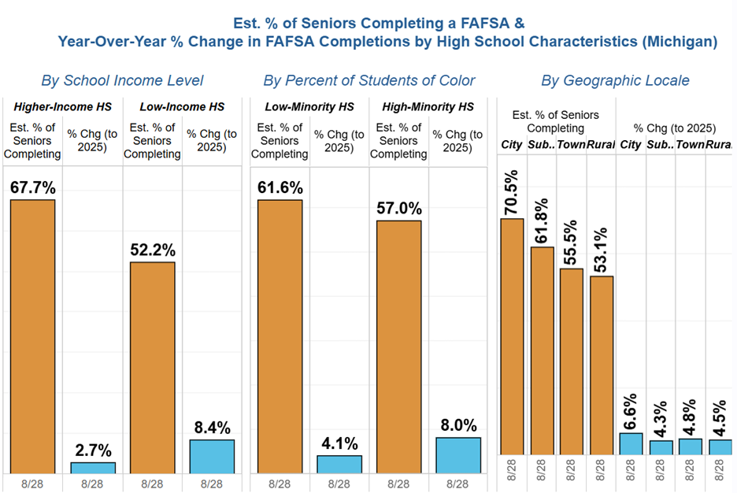
- An estimated 68% of seniors in higher-income high schools completed the FAFSA, compared with 52% in lower-income high schools — a gap of nearly 16 percentage points.
- Completion reached nearly 62% in schools serving lower shares of students of color, compared with 57% in schools serving higher shares of students of color.
- Completion varied substantially by geography, ranging from 71% in city schools to 53% in rural schools.
There were also signs of progress. FAFSA completions increased by about 8% in both lower-income high schools and in schools serving higher shares of students of color. These increases are larger than those recorded by majority-white and higher-income high schools. These gains are encouraging, but substantial disparities remain.


 October 12, 2026 by Kimberly Clarida